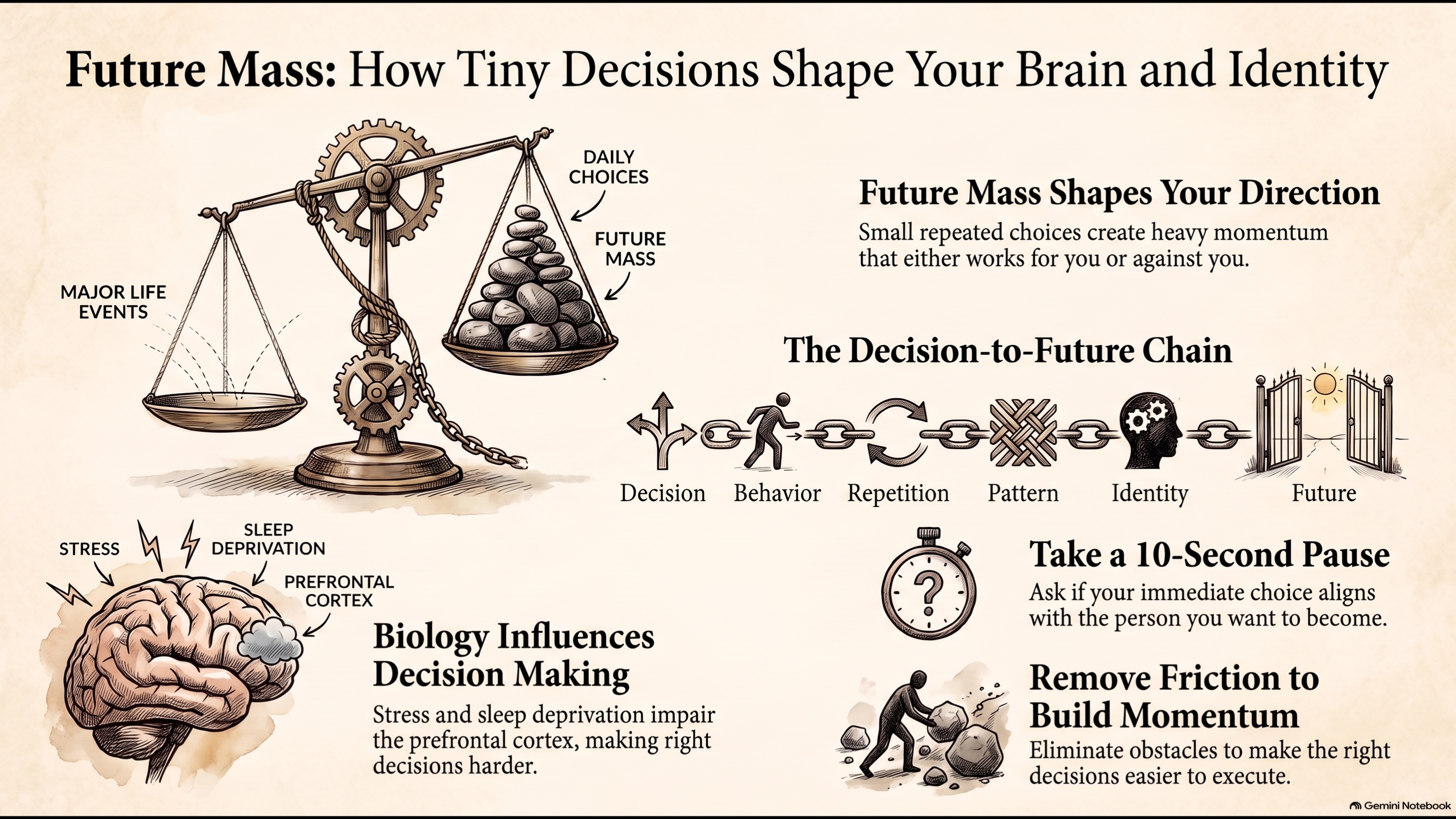
How Tiny Decisions Shape Your Brain, Habits & Future Identity
You know what nobody talks about? The fact that your future isn’t being built in the big moments. It’s being built in the moments nobody’s watching.
Think about it. We’re obsessed with the major life events—the promotion, the diagnosis, the wedding, the business launch. We think that’s when everything changes. But here’s the uncomfortable truth: by the time those big moments arrive, your future has already been shaped by thousands of tiny decisions you made when nobody was looking.
The decision to hit snooze. The decision to scroll for another hour. The decision to keep the promise you made to yourself. The decision to break it. The decision to send the email or stay silent. The decision to move or make an excuse.
These aren’t dramatic moments. They’re invisible forces. And they’re everything.
The Physics of Your Future: Understanding “Future Mass”
Let me paint two pictures for you.
Person A: Wakes up and hits snooze. Not a big deal, right? Tomorrow, they do it again. They skip their workout. They put off the hard conversation. They spend money they don’t have. They stay up late scrolling. They keep saying “I’ll start Monday.”
None of these decisions feels life-changing in isolation. But stack them together for five years? Now they have mass. Now there’s weight. Now there’s resistance. Now changing direction feels nearly impossible.
Person B: Wakes up and gets 10 minutes of movement. Drinks water. Eats a breakfast that supports their energy. Spends 10 minutes learning something new. Makes one sales call. Keeps one promise to themselves.
Again, nothing dramatic happened. But repeat that for five years, and they have something completely different: evidence, confidence, skill, strength, relationships, knowledge, momentum, and identity.
I call this concept “future mass”—the accumulated weight of your repeated decisions. And here’s the game-changing part: future mass can work for you or against you.
The question isn’t “What’s one huge thing I need to do to change my life?” The real question is: “What decision am I making repeatedly?”
Because repeated decisions become patterns. Patterns influence behavior. Behavior influences outcomes. And outcomes influence identity. That’s the chain: Decision → Behavior → Repetition → Pattern → Identity → Future.
Your Brain Is a Learning Machine (Whether You Like It Or Not)
Your brain doesn’t want you reinventing your life every single morning. Imagine having to consciously decide how to walk, brush your teeth, tie your shoes, or drive. That would be exhausting. So your brain learns patterns. It learns what gets rewarded. It learns what gets practiced. It learns what feels familiar.
Here’s the problem: your brain doesn’t automatically know if a pattern is good for you. It just learns repetition.
This means you can accidentally train yourself into a life you don’t actually want. You can practice avoidance. You can practice procrastination. You can practice negative self-talk. You can practice staying small. And eventually, that behavior can feel automatic.
But here’s the good news: you can also practice courage. You can practice discipline. You can practice movement. You can practice following through. And that can become familiar too.
Every time you make a decision that aligns with the person you want to become, you’re casting a vote for that identity. Your behavior gives you evidence about who you are. And that’s how your future starts gaining mass—the right kind of mass.
Why the Right Decision Is Harder Than It Should Be
Here’s something we don’t talk about enough: you don’t make decisions in a vacuum.
Your decisions are influenced by your environment, your stress level, your sleep, your emotions, your energy, your habits, your attention, and your brain’s perception of risk. This matters because sometimes you think I’m lazy. I’m undisciplined. I’m broken. But your biology might be influencing how difficult that decision feels.
Stress disrupts your prefrontal cortex—the part of your brain responsible for clear thinking, attention, and goal-directed behavior. When you’re stressed, overwhelmed, hungry, and exhausted, your brain literally can’t make decisions as effectively. It’s not a character flaw. It’s neuroscience.
Sleep is even more underrated. When you don’t get enough sleep, your prefrontal cortex is particularly sensitive to that loss. Research shows sleep deprivation is associated with impaired judgment and greater risk-taking. So if you stay up scrolling until 2 a.m., wake up exhausted, skip your workout, and then beat yourself up at noon for lacking discipline—pause. Your environment and biology matter.
This isn’t an excuse. It’s an explanation. And explanations are powerful because once you understand the mechanism, you can change the system.
The Dopamine Decision: Now vs. Later
You’ve probably heard dopamine called “the pleasure chemical.” That’s an oversimplification. Dopamine is involved in reward, motivation, learning, and decision-making.
Here’s what matters: your brain pays attention to what feels rewarding. Some rewards are immediate—scroll now, feel good now, buy now, eat now, avoid the conversation now. The future reward? That’s later. And your brain has to weigh: immediate gratification versus delayed benefit.
Some of your hardest decisions aren’t between good and bad. They’re between good now and better later. That’s a completely different battle.
Five Practical Decisions You Can Make Today
You don’t need to transform your entire life overnight. You need to change the next decision, then the next one, then the next one.
1. The 10-Second Pause
Before making an emotionally charged decision, pause for 10 seconds (not 10 minutes—10 seconds). Ask: Is this decision helping the person I want to become? This creates space between stimulus and response, giving your thinking brain a chance to participate instead of simply reacting.
2. The Five-Minute Challenge
Pick one thing you’ve been avoiding and do it for five minutes. Walk outside. Write the email. Clean the room. Start. Action creates evidence, and evidence builds identity. You’re telling your brain: I’m a person who starts.
3. The If-Then Plan
Write down one implementation intention: If [blank] happens, then I will [blank].
- If I feel like skipping my workout, then I will move for five minutes.
- If I want to order food, then I will drink water and wait 10 minutes.
- If someone triggers me, then I will wait before responding.
Make the decision before the moment arrives. Your future doesn’t need more intentions—it needs better systems.
4. Remove One Piece of Friction
You don’t always need more motivation. Sometimes you need fewer obstacles. Want to work out? Put your shoes beside the bed. Want to eat better? Make the healthy choice easier to reach. Ask yourself: What is making the right decision harder than it needs to be? Then remove one piece of friction.
5. The Tomorrow Question
Before bed tonight, ask: What is one decision I can make tomorrow that future me will thank me for? Write it down. One decision. Not 20. Just one.
The Bottom Line
Your future isn’t being built in the moments everyone’s watching. It’s being built in the moments nobody sees. In the tiny decisions that feel insignificant today but compound into your entire life.
You don’t have to change everything. You just have to change the next decision. Then the next one. Then the next one.
Because that’s how warriors are made. Not in one heroic moment, but in a thousand small moments of choosing discipline over comfort, action over avoidance, and progress over perfection.
Ready to dive deeper into how invisible forces are shaping your life? Listen to the full episode of The Warriors Haven Podcast to explore the neuroscience behind decision-making, habit formation, and identity. Because understanding how your brain works is the first step to rewiring it. Subscribe now and start building the future you actually want.