Stop Attacking Your Willpower: 6 Science-Backed Secrets to Resetting Your "Warrior Brain"
- The Discipline Trap
Look at your patterns. You promise to shut down early, yet you’re still scrolling at 1:00 AM. You swear this is the week you’ll hit the gym, but your shoes are gathering dust while you find yourself “tactically” reorganizing your kitchen at midnight to avoid a real challenge.
When you fail, you blame a lack of willpower. You think you’re weak. You’re wrong. True discipline isn’t about white-knuckling your way through a choice; it’s about training your brain’s predictions.
As a strategist, I can tell you: your brain isn’t failing you it’s doing exactly what you’ve trained it to do. To reset your “Warrior Brain,” you must stop asking how to be more disciplined and start asking, “What am I repeatedly training my brain to expect?”
- Your Brain is a Prediction Engine, Not a Choice Machine
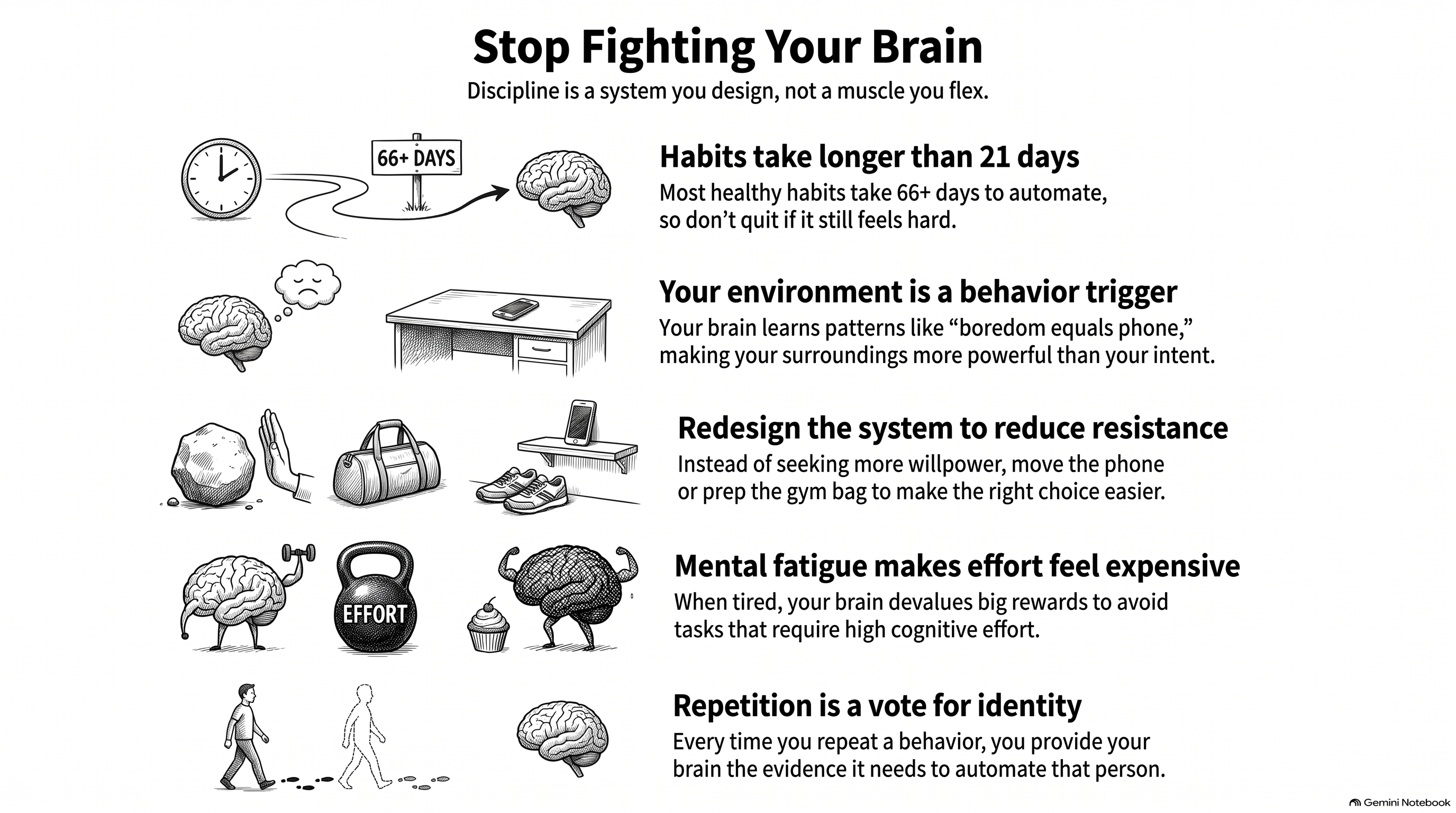
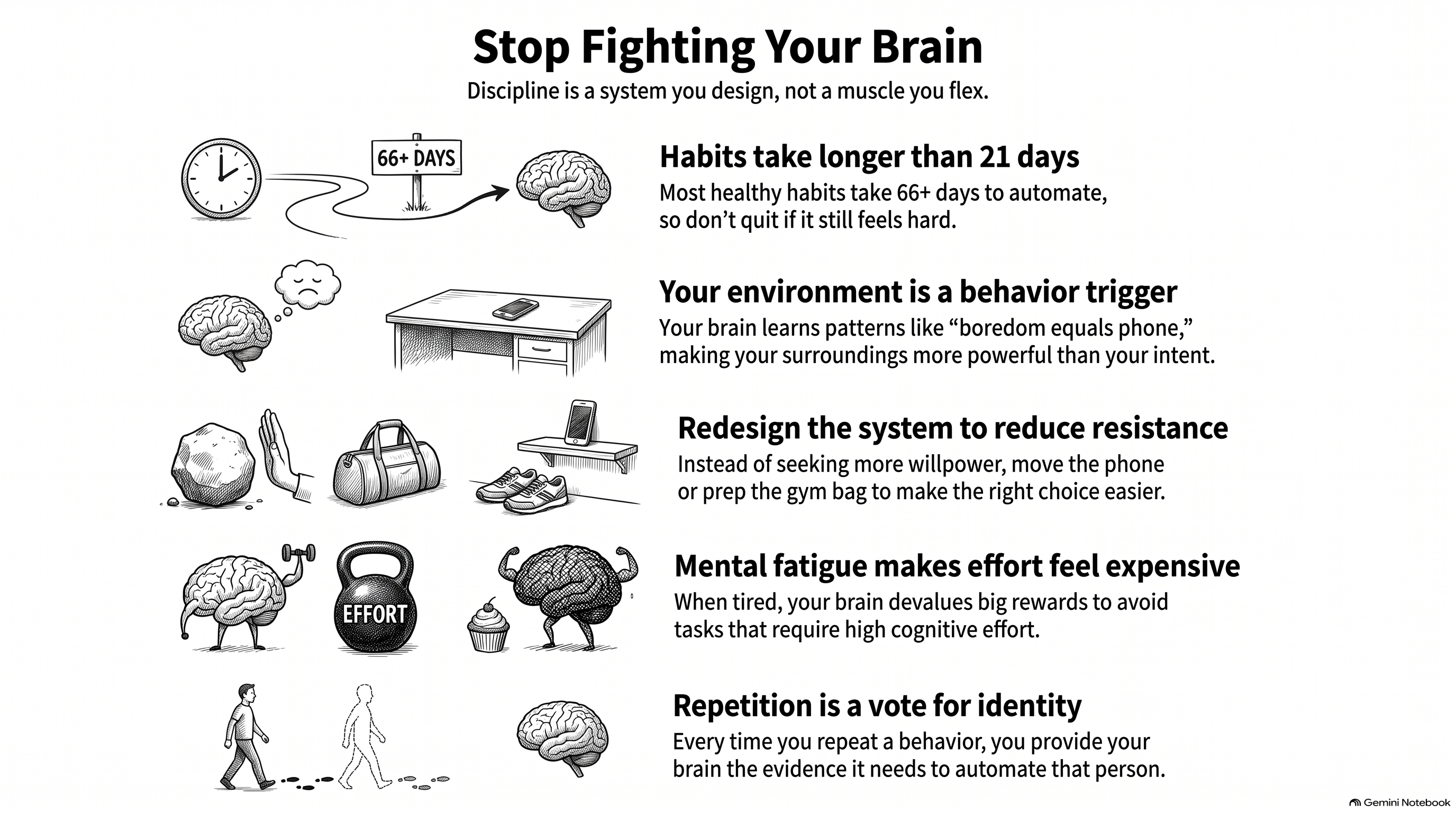
Your brain doesn’t just react to the world; it models it. It creates a predictive map so you can function without thinking. You don’t “choose” where the light switch is; your brain predicts its location. This same mechanism governs your habits. If you reach for your phone every time you feel a hint of boredom, your brain learns a hard-coded prediction: boredom equals phone.
When you try to change, it feels “strange” or uncomfortable because you are forcing your brain to scrap a working model and create a new prediction from scratch. You aren’t fighting a lack of motivation; you’re fighting a pattern.
“Your brain is constantly predicting: what usually happens next? What gives me a reward? What takes the least effort? What feels familiar? What have I done in this situation before?”
- The “21-Day Habit” is a Myth
Stop holding yourself to a fake timeline. The popular “21-day rule” is a lie that sets you up for shame. A 2024 systematic review and meta-analysis proves that habit formation is a marathon, not a sprint.
The actual data for building automaticity is far more demanding:
59 days: The median time for a healthy habit to take hold.
66 days: The median time to reach high automaticity (where you do it without thinking).
106–154 days: The timeline for complex physical habits like morning or evening stretching.
This is why Army basic training is nine weeks exactly 66 days. We don’t just want you to know the drills; we want your brain to automate them. If you’ve been struggling for three weeks, you aren’t a failure. You’re just halfway through the recon phase.
- Mental Fatigue Makes Effort “Expensive”
Discipline often crumbles due to “cognitive fatigue” the mental exhaustion that follows high-demand work. A 2024 neuroscience study revealed that fatigue fundamentally alters your brain’s “cost calculation.”
When you are mentally fresh, “Option B” (the harder task with the bigger reward) looks worth it. But once you’re drained, your brain’s operating system recalibrates. The effort required for the better choice suddenly feels too “expensive,” and your brain defaults to the cheapest, easiest path. This isn’t laziness; it’s resource management. To win, you must stop putting your high-value thinking at the end of the day when your “budget” is empty.
- Recon Your Environment: Why Cues Overrule Willpower
Here is the strategist’s secret: When cognitive fatigue hits, your environment becomes your destiny. Your brain no longer has the energy to fight the triggers around it. Habits are automatic responses to specific cues location, time, and even emotions. If you always eat dessert while watching TV, the television itself becomes the trigger for sugar cravings.
Stop asking, “How strong is my willpower?” Ask, “How much willpower does my environment require?” If your phone is on your nightstand, your system requires constant resistance. If your workout isn’t on the calendar, your system requires constant negotiation. Redesign the environment so the “good” choice is the cheapest one for a tired brain to make.
- The “Movement Snack” and Tactical Readiness
Many high-performers think a 30-minute workout negates 15 hours of sitting. The science says otherwise. A 2025 umbrella review of 48 meta-analyses found that sedentary behavior increases mortality risk regardless of your gym time.
Crucially, the review found that the “Warrior Brain” benefits most from a combination of aerobic and resistance exercise. But beyond the gym, you need “movement snacks.”
Take the stairs… always.
Conduct “walking recons” while on the phone.
Park at the back of the lot.
Execute a two-minute stretch between deep work sessions.
Don’t just “exercise once.” Keep your physiological systems “switched on” across the entire day.
- Loneliness is a System Failure
Connection isn’t a “soft” luxury; it is a physiological requirement. A systematic review of 90 studies involving 2.2 million people found that social isolation increases death risk by 32%, and loneliness by 14%.
When you isolate yourself to “fix your life,” you make your operating system heavier. You were not designed to carry the mission alone. Isolation drains the very resources you need for discipline.
“Sometimes the strongest thing you can do for your operating system is reconnect it to other human beings.”
- Practical Exercise: The 5-Question System Reset
Use these five questions to conduct a tactical audit of your habits. Answer them sharply:
What specific behavior am I changing? (e.g., “I will walk for 20 minutes after dinner.”)
What is the immediate cue? Identify the exact time, location, or emotion that triggers the old response.
What is the reward? Determine what the old habit gives you stimulation, relief, or comfort, and find a replacement.
How do I make the new behavior the “cheapest” option? Move your gear, prep the food, or block the time. Make the first step dead-obvious.
What am I going to repeat until it is normal? Not until it feels exciting… until it feels normal.
Conclusion: Build a Smarter System
Discipline is not the ability to suffer indefinitely. It is the ability to build conditions that make the right behavior the easiest one to repeat. Every repetition you execute is more than just a task; it is a vote for who your brain is learning to become.
If your strategy is failing, do not attack yourself. Study the system. Next time you slip up, don’t ask why you’re undisciplined. Ask, “What did I train today?” Every repetition provides your brain with evidence. Ensure you are training for the life you actually want.
Stop training yourself to “try harder.”
Train your brain to expect better.