Stop Wearing Your Exhaustion Like a Badge of Honor: A Drill Sergeant’s Guide to Beating Burnout
Mission Briefing: The Invisible Battery at 3%
Listen up. Imagine waking up tired before your feet even hit the floor. Your phone is already buzzing, your mind is racing, and before the day has officially started, you feel like you’re already falling behind. You’re thinking about the bills, the emails, the kids, the business and you’re telling yourself you just need to push harder.
I’m Jeshia Sutherland, retired Army drill sergeant, single mother, and founder of the Warriors Haven. I’ve seen the front lines of burnout, and I’m here to tell you to gear up and lock in, because we’re fixing this. We’ve fallen into a trap where we confuse being “busy” with being “successful.” We’ve embraced a cycle of “push, perform, produce, crash,” recovering just enough to do it all over again. That isn’t discipline; it’s a slow-motion collision.
Takeaway 1: Burnout Whispers Before It Screams
There is a fundamental difference between having a long day and experiencing true burnout. Everyone has stressful shifts, but burnout is what happens when the stress piles up and you refuse to give your body and mind the recovery they demand.
In our “Invisible Forces” conversations, we recognize that burnout is often unseen. No one sees the struggle inside your head; they only see the smiling exterior. But there are red flags. It starts with a loss of interest, irritability, mental fog, and chronic procrastination. But the real “danger close” signal? It’s when you start saying, “I don’t care anymore.” That sentence should get your attention immediately. That is the whisper before the scream.
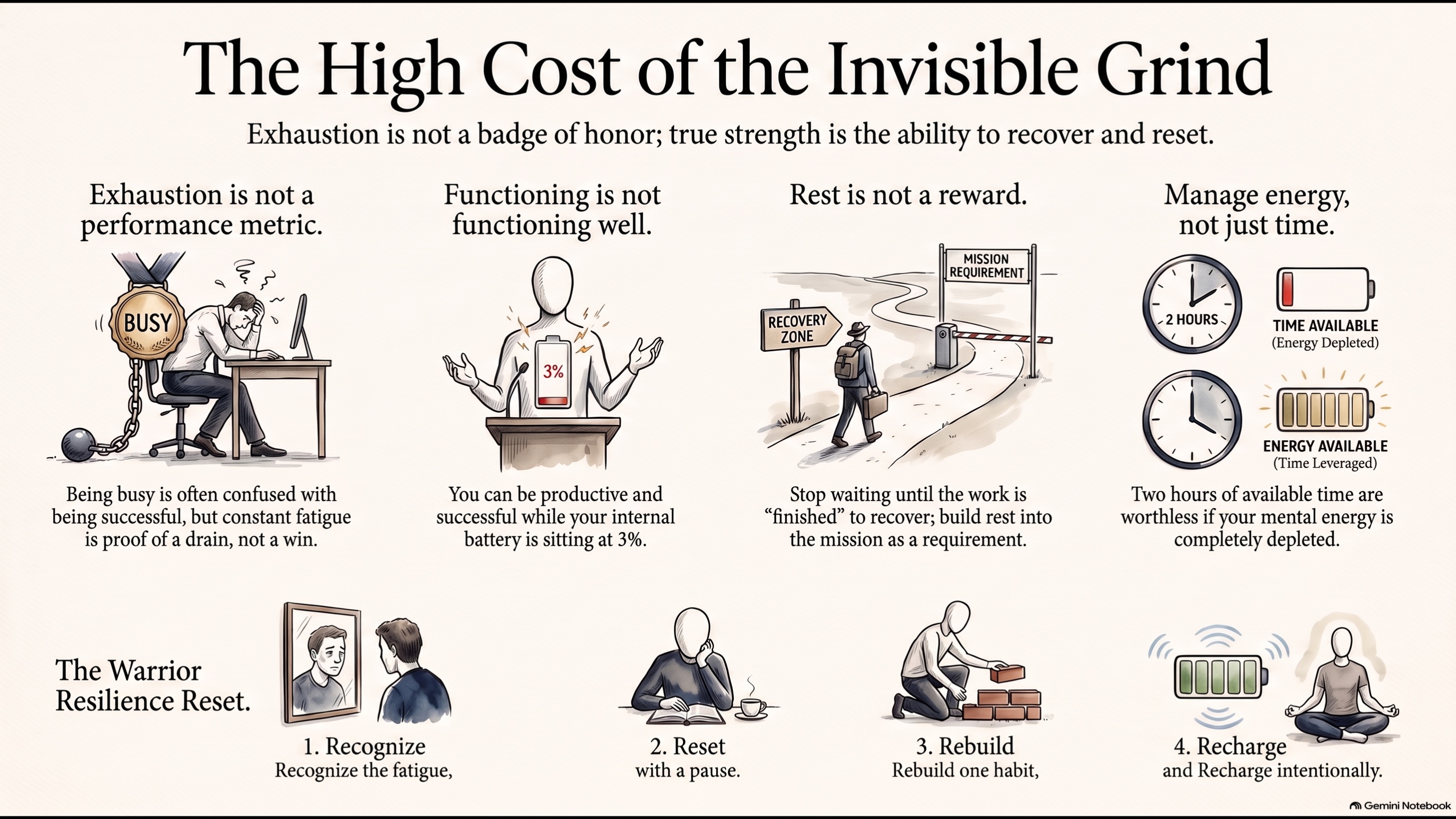
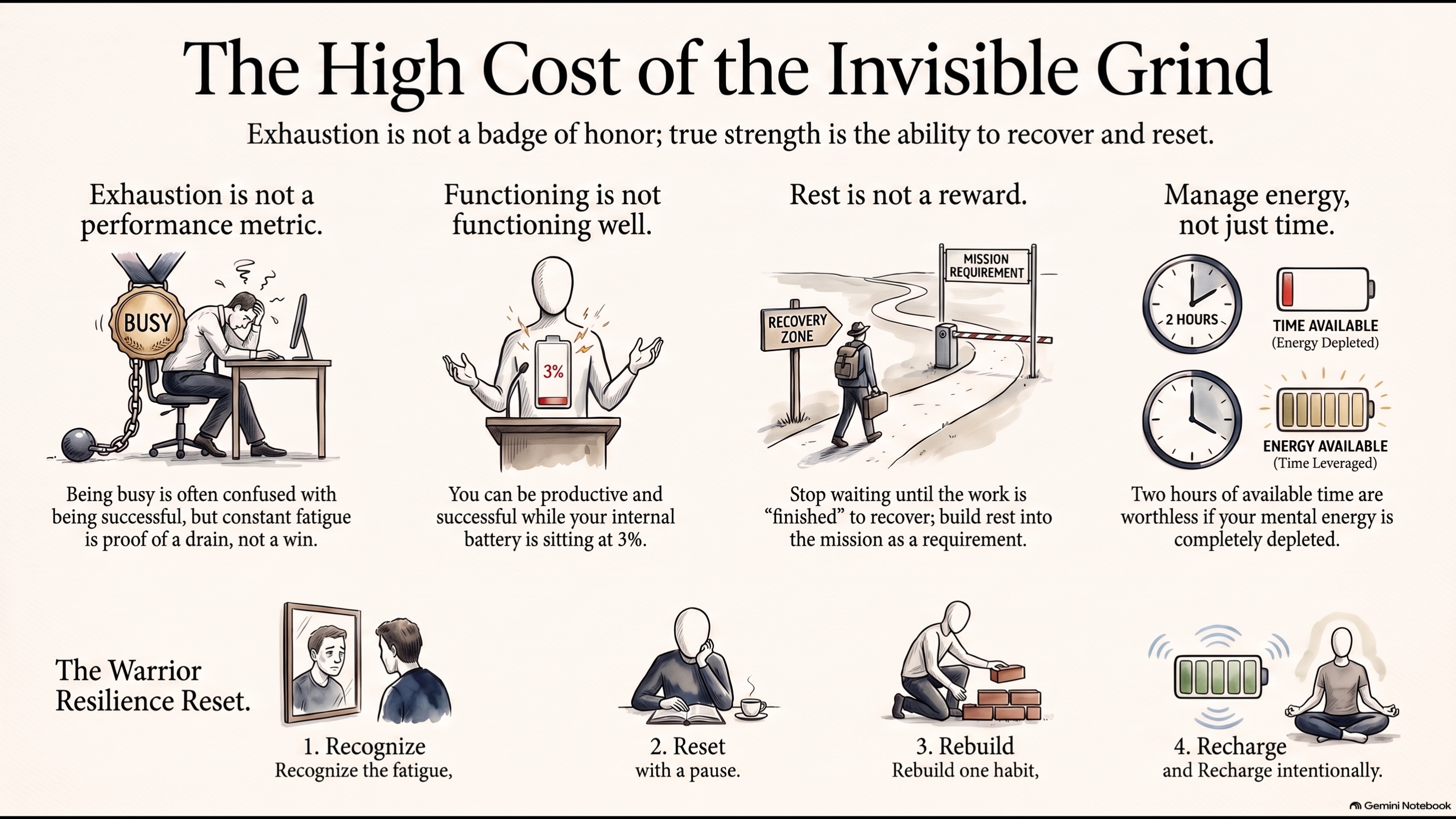
“Nobody sees what is happening inside your head. They see you showing up, they see you working… they see you smiling, but they don’t see the internal battery sitting at 3%.”
Takeaway 2: Functioning is Not the Same as Functioning Well
I need you to hear this: Productivity is not a sign of health. You can be successful and burnt out simultaneously. You can be disciplined and still desperately need a break. Strength doesn’t mean never getting tired; it means having the tactical awareness to know what to do when you are.
If you want to know where you stand, you need to conduct a “Burnout Check.”
Answer these five questions with total honesty:
Do you wake up already feeling mentally tired?
Do simple tasks that should take 10 minutes feel like an entire mission?
Have you become more easily irritated by small things or people?
Have you stopped doing the activities that normally recharge you (hobbies, exercise, laughing)?
Do you constantly tell yourself that you will rest “later”?
Takeaway 3: Stop Measuring Worth by Tolerance
Now, let’s get one thing straight: being exhausted is not proof that you’re winning. Somewhere along the way, we started glorifying the grind like skipping meals and losing sleep were medals of valor. They aren’t. They are signs of poor resource management.
I don’t care how many hours you worked; I care about what those hours produced.
Stop measuring your worth by how much stress you can tolerate and start measuring it by how well you can sustain your life. This is about shifting from Time Management to Energy Management. Your mental energy is a finite resource. If your tank is empty, it doesn’t matter if you have four hours of “free time”… you won’t be effective.
“Exhaustion is not a performance metric.”
Takeaway 4: Rest is Part of the Mission, Not a Reward
Now, I’m going to get a little drill sergeant on you. Stop acting like rest is a prize you earn only after the “to-do” list is empty. The work is never finished. If you wait for the end, you’ll wait forever.
Look at elite athletes. They don’t train 24/7 because they know that recovery is where the adaptation happens. Your brain, your body, and your nervous system require downtime to rebuild. One of your primary orders is to establish a “shutdown time”… a non-negotiable boundary at 6 p.m., 7 p.m., or 8 p.m. where the phone goes down and the brain gets the signal that the mission is complete.
“The people who depend on you don’t need your productivity. They need you, your presence, your mind, your energy, your heart, your life.”
Takeaway 5: The Warrior Resilience Reset
Resilience is a skill, and like any move on the firing range, it requires repetition. It is the ability to face difficulty, adapt, and move forward. To break the cycle, use the Warrior Resilience Reset framework:
Recognize: Acknowledge the overwhelm without shame. Awareness is the starting point.
Reset: Take five minutes. Stretch, pray, meditate, or sit in total silence. Give your brain space.
Rebuild: Pick one area to fix—just one. Maybe it’s your sleep schedule or a specific boundary.
Recharge: Do something that makes you feel like yourself again. Put on music, get into nature, or move your body.
Repeat: Resilience is a collection of small, daily decisions.
If you’re pinned down by stress right now, execute the Five-Minute Burnout Reset:
What is draining me right now?
What can I control?
What can I stop doing?
What do I need today?
What is one small thing I can do to feel 1% better?
Conclusion: From Surviving to Thriving
You don’t have to rebuild your entire life tonight; you just have to stop repeating the habits that destroy your energy. Remember, asking for help is not a sign of weakness… it’s a resource used by the resilient. You cannot pour from an empty cup and call it strength. Eventually, there is nothing left to pour.
Move from merely surviving to actually living. Keep me 18 inches from your heart and remember: you don’t have to wait for your body to force a shutdown. You can choose to recover smarter starting right now.
What is your biggest energy leak, and what is the one thing you will change today to stop it?