The Dyslexic Advantage: Why Your "Weakness" is a 2% Edge in a 1% World
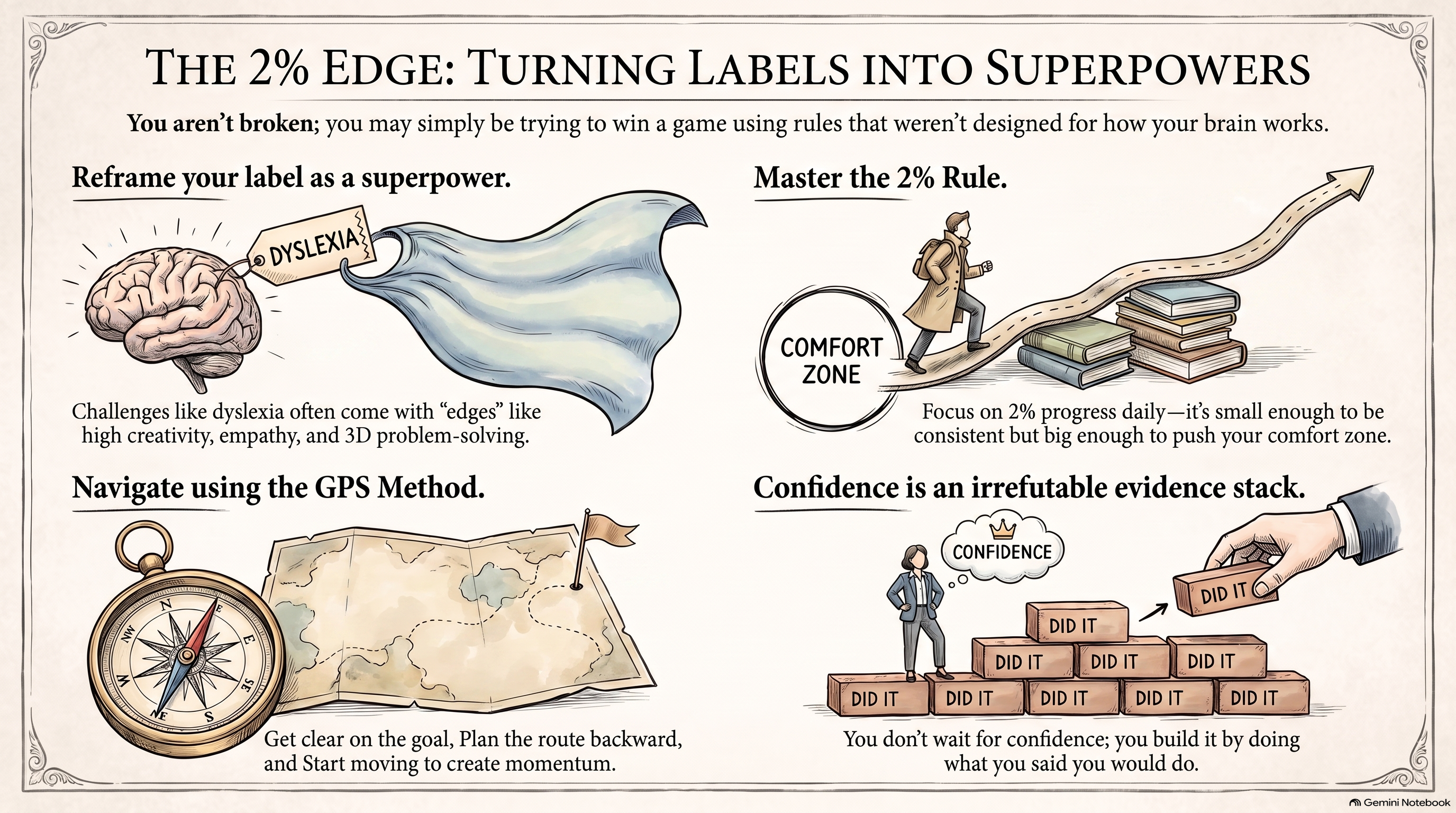
The Dyslexic Advantage: Why Your “Weakness” is a 2% Edge in a 1% World
- Introduction: The Hidden Gift in Your Greatest Challenge
Cognitive friction often manifests as a “lag” in our professional and personal trajectories. We have all experienced that heavy sensation of being fundamentally “behind” the quiet, corrosive weight of feeling broken.
Whether it stems from a formal diagnosis like dyslexia or ADHD, or simply the internal comparison to high-achieving peers, we often treat our unique cognitive architectures as anchors keeping us from the starting line.
Coach Willie Blake’s story begins in this exact place of isolation. For years, he viewed his dyslexia as a secret to be managed and a limitation to be hidden.
However, the highest level of performance is reached only when we realize that the labels we are given are merely stories we have attached to ourselves, not objective limits. To move from stagnation to momentum, we must reframe these perceived disabilities into a tactical edge.
- Reframing the Label: From Execution Bottleneck to Nine Superpowers
The “bottleneck” of a label is best illustrated by a visceral moment in Coach Blake’s history: a high school chemistry class with his favorite teacher, Mr. Beanick. Willie sat in the front row, having meticulously solved complex molecular equations. He had the right answer on his paper. But when he raised his hand and spoke, the words that left his mouth were different from the symbols on the page. He was told he was “incorrect,” only to hear a classmate repeat the exact answer Willie had written moments later.
That moment of humiliation is the ultimate example of how a label creates a bottleneck in execution, leading to a “negative stack of evidence.” The shift to high performance happens when you stop focusing on the verbal “glitch” and start auditing the cognitive strengths that produced the right answer in the first place.
In a modern entrepreneurial environment where systems architecture, product design, and rapid innovation are the primary currencies the dyslexic mind possesses nine specific “superpowers” that offer a competitive advantage:
3D Creativity: The ability to manipulate concepts spatially.
Visualizing in Vivid Color: A high-definition internal imagination.
Perspective: Seeing problems from angles others ignore.
Problem Solving: Non-linear approaches to complex hurdles.
Recognizing Patterns: Identifying trends in data or behavior before they surface.
Simplified Communication: An inherent distaste for jargon, allowing for elite-level clarity.
Empathy: A deep relational capacity born from navigating personal challenges.
Sympathy: The ability to connect with others “in the trenches.
3D Concept Imaging: The capacity to build and test mental models in three dimensions.
These aren’t just “coping mechanisms”; they are elite tools for leadership and innovation. As Coach Willie notes:
“Your label does not have to become your limit.”
- The 2% Rule: The System for Iterative Growth High-performance growth is frequently derailed by the binary trap of perfectionism. To drive professional optimization, Coach Blake utilizes the 2% Rule, a framework for micro adjustments that bypasses the brain’s fear response.
100% Focus (The Buffet Trap):
Attempting to overhaul your entire life at once. Like a plate piled too high at a buffet, the sheer volume of tasks leads to “analysis paralysis.” You become immobile because the goal is too heavy to lift.
1% Action (The Comfort Zone Trap): While consistent, 1% often stays within the realm of the “easy.” It represents tasks like organizing your desk or checking emails , activities that feel like work but don’t move the needle.
2% Action (The Progressive Edge): This is the optimization zone. It is just uncomfortable enough to trigger adrenaline and drive progress, but small enough that it doesn’t cause systemic failure. It is the phone call you’ve been avoiding or the difficult conversation you’ve delayed.
By executing at the 2% level, you begin to build what Blake calls an “irrefutable stack of evidence” for your own competence.
- The GPS Method: A Tactical Framework for Momentum
To move from “stuckness” to execution, you need a navigational system that prioritizes clarity over emotion. The GPS Goal Model reverse-engineers success through three phases:
G: Get Clear (Brutal Honesty) You must identify what you want, independent of societal or familial expectations. This requires “brutal honesty” about your starting point. Just as one might have to admit, “I’m sitting here with a keg [belly] and need to lose weight,” a professional must acknowledge the “debt” or “stagnation” in their current career to find a true coordinate for the next move.
P: Plan the Route (Reverse Engineering) Start at the finish line and work backward. By identifying the final milestone and tracing the steps back to the present, the “next immediate move” becomes obvious, removing the friction of choice.
S: Start Moving (The Low-Friction Entry) The hardest part of any journey is the transition from zero to motion.
Sub-Tactic: One Minute, One Thing. If you are paralyzed by a project, set a timer for 60 seconds.
Commit to doing one single thing opening the document, making one note, or clearing one piece of clutter.
This 60-second window breaks the mental block and generates the physiological momentum required to continue.
- Motion Over Mindset: Changing the State
Mindset is often a lagging indicator of physiology. When you are trapped in a loop of self-doubt, you are usually in a stagnant physical state head down, shoulders slumped, scrolling. To halt a negative thought pattern, you must utilize a “disruption technique.” Standing up, changing rooms, or engaging in a brief burst of movement forces your mental state to reset.
True confidence is not a feeling to be summoned; it is a data set to be built. As Coach Willie says: “The way to build confidence isn’t about shouting affirmations… it’s about doing what you say you’re gonna do and building an irrefutable stack of evidences that you are who you say that you are.”
- The LIGHT Philosophy: The Operating System
Underpinning these tactical frameworks is the LIGHT Philosophy, the internal Operating System (OS) that gives the 2% Rule its purpose. Without this foundation, discipline eventually feels like a chore rather than a mission:
L: Love
I: Inspire
G: Gratitude
H: Hope
T: Time
While each element is vital, Time is the most critical resource. It is the only thing we truly possess. High performance is the art of using the time we have each day to build the life we want, 2% at a time.
- Conclusion: Rebuilding the Rules of the Game
Success is not a matter of becoming “normal” or erasing the traits that make you different. If you have spent years feeling like you are failing, you are likely not “broken” you are simply trying to win a game using rules that were never designed for your specific brain.
Your mission is not to conform, but to master your own cognitive architecture and rebuild your environment around your unique strengths. Whether your label is dyslexia, ADHD, or any other perceived limitation, it is simply the starting point for your unique edge.
The 2% Challenge: What is the one uncomfortable 2% move you’ve been avoiding because you’re waiting to feel “ready”? I don’t need you to feel ready; I just need you to move. Perform that one action today.