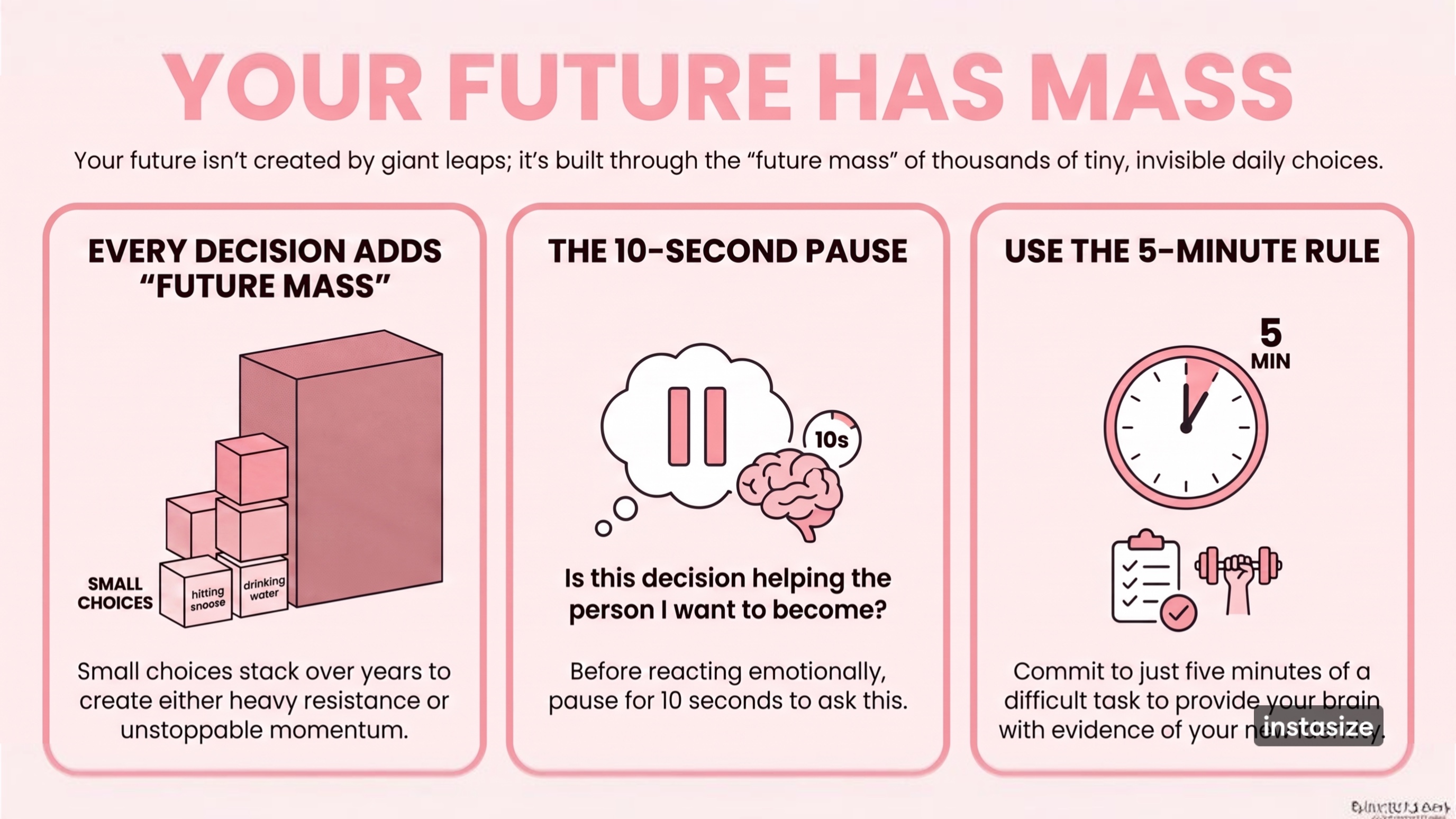
The Physics of Your Future: Why Tiny Decisions Carry the Most Weight
The Myth of the “Big Moment”
Gear up and lock in. We’re taught to believe that life changes only during the “Big Moments”—the promotion, the divorce, the move across the country, or the retirement ceremony. We wait for these grand events to redefine us, sitting around for a lightning bolt that rarely strikes.
Here is the uncomfortable truth: your future is being built long before the big moment arrives. It is constructed in the tiny, invisible decisions that nobody else sees. As a veteran drill sergeant, I’ve seen that discipline isn’t about one-time heroics; it’s about the invisible forces—friction, momentum, and repetition—that move your life every single day. Stop waiting for a milestone to change your trajectory. That is where your power lives: in the next ten seconds.
The Metaphor of Future Mass
In physics, mass is the amount of matter in an object. In the context of your life, every decision you make adds “matter” to the direction you are moving. I call this Future Mass.
Consider two people over a five-year period:
Person A hits the snooze button. They stop exercising and put off the hard conversations. They spend money they don’t have, stay up late scrolling, and tell themselves, “I’ll start Monday.” Individually, these are small choices. Stacked together for five years, they create massive resistance. Now, changing direction feels nearly impossible because their future is heavy with the weight of avoidance.
Person B chooses ten minutes of movement each morning. They drink water, eat a breakfast that supports their energy, and spend ten minutes learning something new. They make one extra sales call and keep one small promise to themselves. These aren’t dramatic feats, but after five years, this mass translates into confidence, skill, and momentum.
“Future mass can work for you or against you.”
Your decisions are making your future heavier. The only question is: what are your decisions making your future heavier with? Are you building stability, or are you building a lead weight that will hold you down?
The Identity Chain: From Decision to Destiny
Change isn’t a mystery; it’s a logical, neural progression. It follows a specific chain: Decision → Behavior → Repetition → Pattern → Identity → Future.
Your brain is a prediction machine. It doesn’t want to reinvent your life every morning—it wants to know how to walk, tie your shoes, and drive without thinking. It learns patterns. The problem is that your brain doesn’t distinguish between a “good” or “bad” pattern; it simply learns what is practiced and rewarded.
Every single decision you make is a vote for the person you are becoming. You can accidentally train yourself into a life you don’t want by practicing avoidance or negative self-talk until they feel automatic. Conversely, you can practice courage and discipline until they become your familiar state. Your behavior provides the evidence your brain needs to solidify your identity. You aren’t just “undisciplined”—you are currently casting votes for the wrong candidate.
Why “Laziness” Is Often Biology in Disguise
When you fail to follow through, you might call yourself “lazy” or “broken.” This isn’t an excuse, it’s an explanation: your biology influences how difficult a decision feels.
Deep in the brain, systems involving the orbital frontal cortex, anterior cingulate cortex, and the striatum are constantly evaluating rewards, costs, and choices. In fifth-grade language: your brain is constantly weighing if a task is “worth it.” When you are under significant stress, your prefrontal cortex—the area responsible for executive functions like goal-directed behavior—is disrupted. Stress makes it harder to think clearly.
Compound that with sleep deprivation. Research shows the prefrontal cortex is particularly sensitive to sleep loss, leading to impaired judgment and greater risk-taking. If you’re exhausted and overwhelmed, you aren’t fighting a lack of character; you’re fighting a biological system under fire. Once you understand the mechanism, you can stop beating yourself up and start changing the system so that better decisions become possible.
The 10-Second Gap: Reclaiming Choice
To break the cycle of autopilot, you must create space between the stimulus and the response. You don’t need an hour of meditation. You need the 10-Second Pause.
When you feel an emotional impulse to quit, scroll, or react in anger, stop for ten seconds—not ten minutes, ten seconds. During that gap, breathe and ask yourself one internal question: “Is this decision helping the person I want to become?”
This pause interrupts the reactive mode and allows the thinking part of your brain to participate. You aren’t trying to eliminate your emotions; you are giving yourself the opportunity to choose your direction rather than simply reacting to the moment.
Implementation Intentions: If-Then Planning
Willpower is an unreliable resource that fails when you’re tired. To close the gap between intention and action, use Implementation Intentions or “If-Then” plans. These work because they prevent your brain from negotiating from scratch when you are stressed.
For Exercise: “If it is 6:00 PM, then I will put my shoes on and walk for ten minutes.”
For Habits: “If I catch myself scrolling after 10:00 PM, then I will put my phone across the room.”
For Health: “If I want to snack at night, then I will drink water first and wait ten minutes.”
By making the decision before the moment arrives, you bypass the mental struggle. You’ve already signed the orders; now you just follow them.
Meeting Your Future Self
One of the most powerful tools for evaluating your choices is to view your “Future Self” as a real person who has lived the consequences of today’s actions.
Imagine that person walking into the room ten years from now. They know what you avoided. They know what you started and what you quit. They know exactly what you tolerated. If they asked you, “Why did you keep choosing that?” would you have an answer you’re proud of?
“Your future self is simply you with more consequences.”
Reflecting on this perspective helps you realize that small choices aren’t just about today—they are about protecting or ignoring the person you will become.
Conclusion: Three Questions for a New Trajectory
Small things repeated are never small. Your life is the result of what you repeatedly choose. When you fail or fall off the wagon, you fall back on the Warrior Code: You make a decision, you learn, you adjust, and you choose again. You keep moving.
To shift your trajectory today, ask yourself these three questions:
What decision am I repeatedly making that adds weight to the future I don’t want?
What decision could I make today that would add weight to the future I actually want?
What would future me thank me for doing today?
You don’t need a massive breakthrough. You only need one tiny vote that says “not this time” to an old habit. Choose differently, add the right mass to your future, and start moving. I’ll see you in the fight.