Why Your Body Won't Stop Fighting at Night: 5 Insights on Recovery, Sleep, and Modern Performance
Related Episode
067: Evening Wind-Down | Create Restful Defense Mechanisms- Catching the Reader: The “Unfinished Day” Paradox
It is 11:30 PM. You are lying in bed, physically exhausted from a grueling schedule, yet your mind is fully engaged in high-arousal tactical mode. Your brain is replaying meetings from mid-afternoon, auditing late-night task lists, and urging you to scroll through your phone just one last time. You have powered down your laptop and physically left your desk, but the operational weight of the workday has not left you.
This widespread friction reveals a fundamental disconnect in modern high-performance culture: stopping work is not the same as letting your body know it is safe to rest.
As podcast host and former Army drill sergeant Jeshia “Jay” Sutherland emphasizes, high achievers are master practitioners of operational response, but they rarely train their bodies how to stand down. When your nervous system spends twelve to sixteen hours continuously responding to deadlines, incoming alerts, and high-stakes demands, it loses the physiological pathway back to baseline. Sustained capability requires building a deliberate “Restful Defense Mechanism”—a structured sequence of environmental and physiological cues that actively signals your biology to transition from high performance to tactical recovery.
- Takeaway 1: Regularity Trumps Duration for Health & Longevity
When high achievers evaluate their sleep architecture, they almost exclusively target a single metric: duration. Public health guidance, such as baseline recommendations from the Centers for Disease Control and Prevention (CDC), routinely advises adults to secure at least seven hours of sleep per night. Yet, for leaders and competitive professionals who treat seven hours as an unattainable luxury, focusing solely on total hours often leads to a cycle of weekday sleep deprivation followed by chaotic weekend sleep binges.
Emerging research indicates that schedule consistency may play a far more decisive role in long-term health and longevity than duration alone.
A landmark 2023 study published using data from over 60,000 participants in the UK Biobank revealed that sleep regularity… going to bed and waking up at consistent times was associated with a significantly lower risk of overall mortality. Crucially, researchers found that sleep regularity was a stronger predictor of lower mortality risk than sheer sleep duration.
This phenomenon aligns directly with basic human chronobiology. Deep within the brain sits the circadian rhythm, an internal 24-hour operating system responsible for regulating core body temperature, hormone release, metabolic health, and cognitive readiness. This system thrives on strict temporal predictability rather than erratic recovery windows.
“Your body likes rhythm. Your body likes predictable signals. Your body likes knowing what comes next.”
For professionals trading consistent sleep schedules for extra operational hours—hoping to “catch up” on off-days this science demands an immediate strategic pivot. Sporadic sleep schedules create internal circadian desynchronization, whereas establishing predictable biological timing provides the required physiological bedrock for sustained, long-term output.
- Takeaway 2: Sleep Is an Active Operating Shift, Not Inactive Time
The primary mental barrier to prioritizing rest is the deep-seated assumption that sleep is passive downtime—an unproductive state of non-existence where progress halts. Neuroscience thoroughly refutes this assumption.
Leading sleep researchers, including Matthew Walker and Robert Stickgold, have demonstrated through extensive empirical work that sleep represents an intense period of active neural processing critical for learning consolidation, memory processing, and brain plasticity.
When you fall asleep, your brain does not power down; it shifts into a specialized background operating mode. It systematically audits the day’s biological and experiential data, organizes memories, reinforces structural neural pathways, and executes metabolic waste clearance to prepare your cognitive system for the next deployment.
Reframing sleep as an active operating shift fundamentally alters how high performers view recovery. You are not “doing nothing” during sleep. Sleep is the active, non-negotiable window during which your brain carries out critical maintenance, systemic repair, and cognitive consolidation that cannot occur while you are awake.
4.Takeaway 3: Environment Controls Biology (The Light and Screen Dilemma)
Human biology is structurally hardwired to respond to environmental inputs. Insights from the National Institutes of Health (NIH) highlight that the human circadian clock relies on environmental light-dark cycles to modulate the endocrine system, specifically regulating the release of melatonin—the biomarker that signals biological night to the body.
Research summarized by Harvard Health stresses that evening exposure to artificial light—particularly the blue-enriched wavelengths emitted by digital monitors, smartphones, and televisions suppresses melatonin production and shifts circadian timing. Historically, the onset of natural darkness provided an uncompromised biological instruction: power down, conserve energy, and initiate physical repair. Modern devices dismantle this natural signaling mechanism.
- What the sun says: The daily mission is complete; reduce internal arousal and prepare for physical repair.
- What your devices say: Here are 47 new high-priority notifications that demand your immediate emotional energy.
- What the sun says: Slow down cognitive processing and conserve energy for tomorrow’s performance.
- What your devices say: Consume one more piece of content; keep your brain engaged.
- What the sun says: Establish physical safety and transition to biological rest.
- What your devices say: Stay on high alert; check your inbox for unfinished business and unresolved conflict.
By operating digital devices late into the night, you subject your nervous system to competing environmental instructions, forcing the brain to remain in a state of hyper-vigilance.
“Your phone is not just a screen. It’s a doorway… a doorway to work, a doorway to comparison, a doorway to arguments, a doorway to breaking news… and sometimes a doorway to your own anxiety.”
Recognizing that digital screens operate as direct environmental directives to stay combat-ready allows you to engineer an evening perimeter that actively protects your biological rhythm.
5.Takeaway 4: The 5-Tool Evening Runway (“The Restful Defense Mechanism”)
Shifting from intense daily operations to physical rest requires an intentional deceleration process… much like bringing an aircraft down a runway before coming to a complete stop. The following 5-tool tactical framework provides a deliberate protocol to drop cognitive load and prime your system for deep recovery.
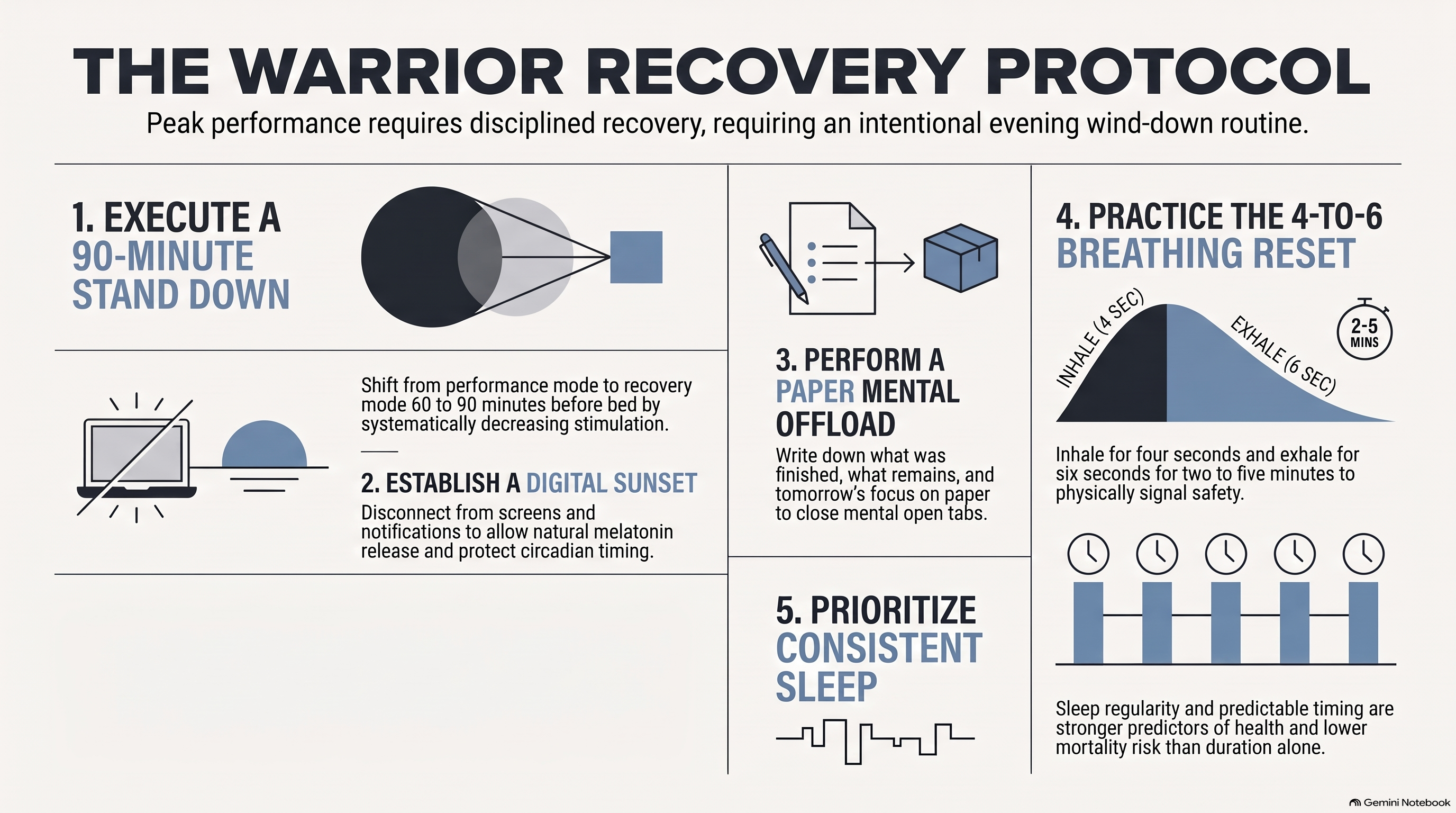
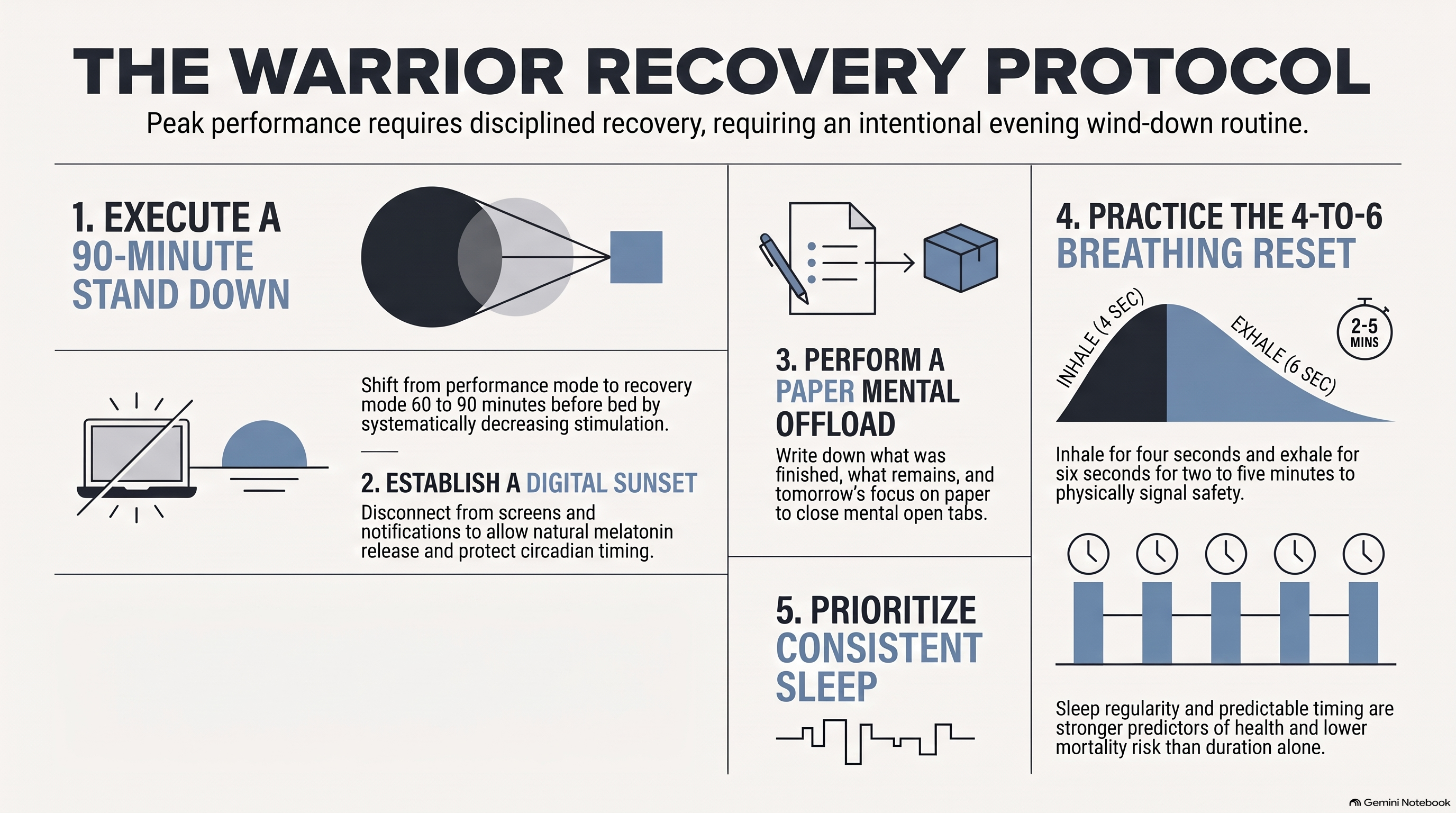
Tool 1: The 90-Minute Stand Down
Initiate a structured wind-down sequence 60 to 90 minutes prior to your target sleep window. The objective is not rigid perfection, but establishing a predictable cadence that signals physiological safety to the brain.
- 90 Minutes Before Bed: Hard stop on all professional work and operational task execution.
- 60 Minutes Before Bed: Lower ambient overhead lighting throughout your living environment.
- 45 Minutes Before Bed: Cease active smartphone usage and messaging.
- 30 Minutes Before Bed: Execute personal hygiene routines and basic physical prep.
- 15 Minutes Before Bed: Engage in quiet, low-stimulation reflection, light stretching, or breathing protocols.
Why it works: Executing a consistent sequence trains the central nervous system through pattern recognition, automatically reducing systemic arousal levels.
Tool 2: The Digital Sunset
Establish an uncompromising evening cutoff time (e.g., 9:00 PM or 9:30 PM) for work emails, social media, news broadcasts, and financial dashboards. Engage “Do Not Disturb” settings, silence non-essential alerts, and physically charge your mobile device across the room away from your sleeping station.
Why it works: Eliminating screen interaction removes high-arousal psychological triggers. Removing the phone from arm’s reach relies on environmental friction rather than draining finite willpower late at night.
Tool 3: The Mental Offload
Before getting into bed, perform a tactile journaling protocol using an analog pen and notebook—never a digital screen. Your body is tired, but your brain is holding open tabs. So we’re gonna close some tabs. Write down three specific categories:
- What I finished today
- What still needs my attention
- What I will handle tomorrow
Conclude the entry by writing the explicit operational boundary: “Tomorrow has its own assignment.”
Why it works: Unprocessed thoughts force the brain to function as an aggressive, late-night project manager. Transferring these items to physical paper externalizes cognitive baggage, allowing your mind to safely close its open tabs.
Tool 4: The 4-to-6 Reset
Assume a comfortable position and execute slow, deliberate vagal breathing. Inhale gently through your nose for 4 seconds, then exhale slowly and smoothly for 6 seconds. Maintain this rhythmic cadence for 2 to 5 minutes. (Note: The American Academy of Sleep Medicine includes relaxation approaches among recognized behavioral strategies that can assist adults with insomnia).
Why it works: Extending the duration of the exhale directly stimulates the vagus nerve, engaging the parasympathetic nervous system, lowering heart rate, and signaling to your biology that you are safe from immediate threats.
Tool 5: The Sleep Sanctuary
Optimize your bedroom environment according to baseline public health guidelines (such as those outlined by the CDC): ensure the room is dark, quiet, cool, and comfortable. Most importantly, reserve the bed strictly for sleep and intimacy… removing work tasks, heated discussions, and digital entertainment from the space.
Why it works: Environmental discipline reinforces a clean psychological association between your sleeping space and physical recovery, preventing operational stress from compromising your rest area.
6.Takeaway 5: Reframing Rest—Recovery IS Discipline
For high-performing individuals, the most formidable obstacle to rest is psychological. Ambitious leaders frequently bind their self-worth directly to continuous output, leading them to view rest as a vulnerability, laziness, or lost momentum.
This posture leads directly to biological bankruptcy. Operating in a state of chronic exhaustion does not demonstrate superior dedication; it systematically degrades decision-making capability, emotional resilience, and physical health. Elite military units do not maintain maximum combat intensity indefinitely, and world-class athletes do not train every hour of the day. Tactical operators intentionally rotate, reset, and recover to preserve operational readiness.
“Rest isn’t the reward for being productive. Rest is part of what allows you to remain productive.”
Being exhausted isn’t a personality. Being busy isn’t an identity. Running yourself into the ground isn’t proof that you care. True discipline is recognizing when operational effectiveness demands that you power down, reset your hardware, and rebuild your baseline for the mission ahead.
- Conclusion: The 7-Night Data Experiment
Rather than attempting to radically overhaul your entire lifestyle at once, approach your recovery like an analytical seven-night protocol. Sometimes you don’t need another motivational speech. You need data.
For the next seven nights, execute a simple trial:
- Fix a consistent target bedtime and wake time.
- Select one or two tools from the evening runway (such as the Digital Sunset or the Mental Offload).
- Begin your wind-down protocol 60 to 90 minutes before sleep.
- Each morning, log three key operational metrics on a 1–10 scale:
- Energy: What is your physical vitality upon waking?
- Focus: How sharp and decisive is your cognitive processing?
- Mood: How steady and biologically resilient do you feel?
Analyze your data for actionable patterns. Observe how eliminating late-night screen exposure alters your sleep architecture, or how offloading open cognitive tabs onto paper clears your morning focus. High-performance recovery does not demand flawless perfection; it requires disciplined repetition.
Tonight, as you step into your bedroom, ask yourself one final tactical question: “What message am I sending my body right now?” Send the explicit message that the mission is complete, safety is secured, and it is time to recover.