Why Your "Hard Work" is Killing Your Results: The New Rules of Sustainable Discipline
- Introduction: The Myth of the Lazy Warrior
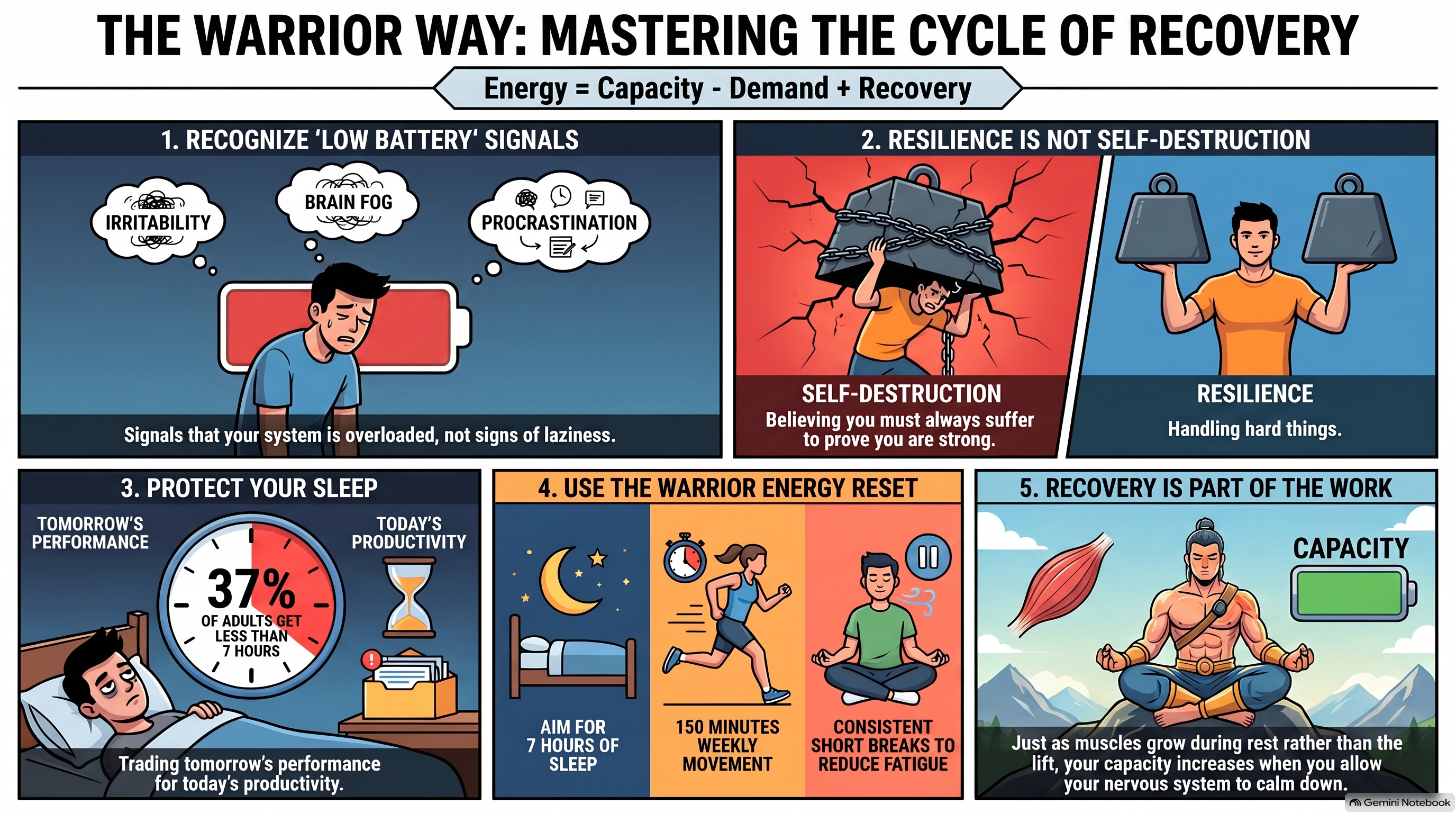
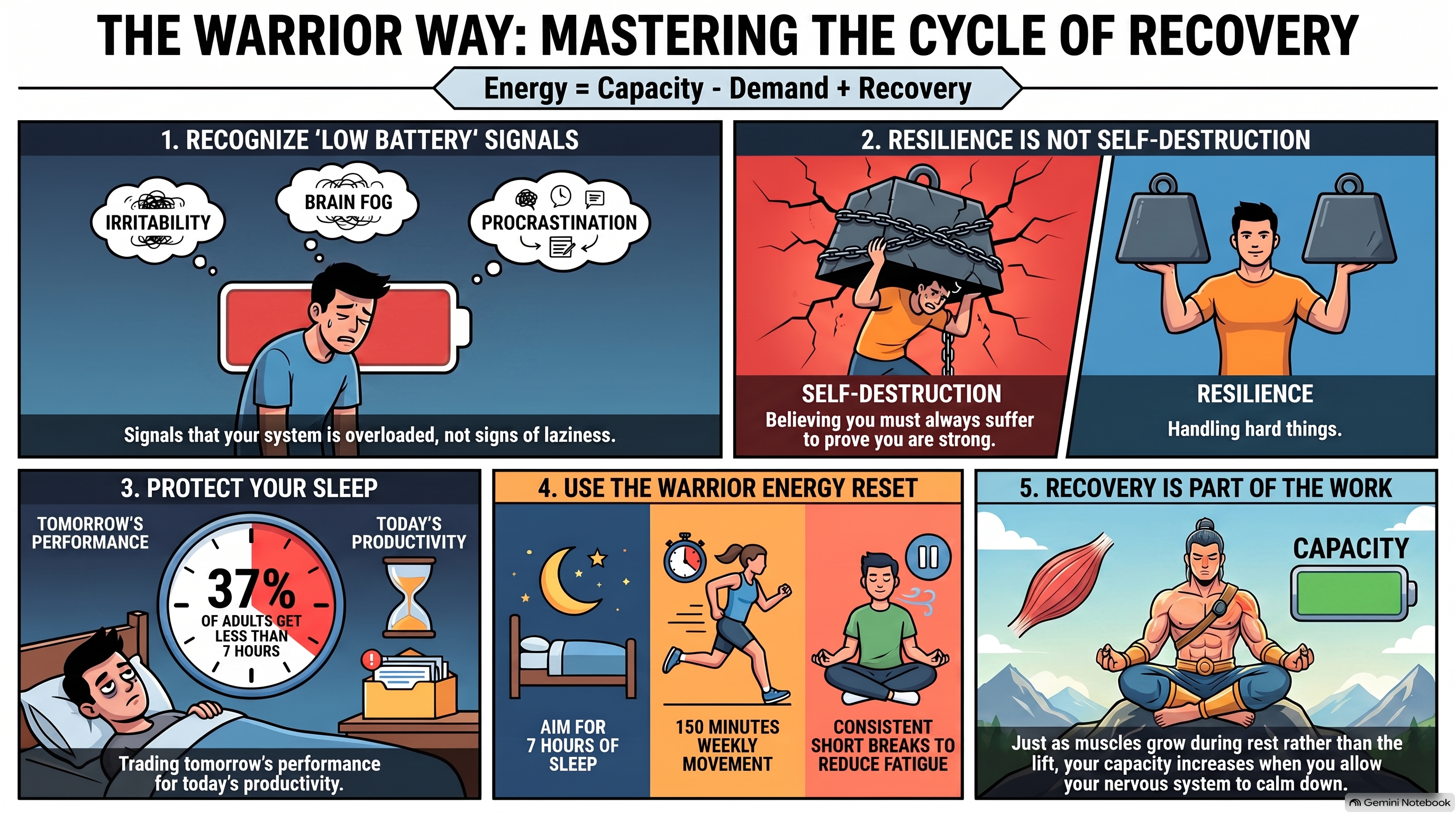
When your output drops and your focus fractures, your instinct is likely to double down. You tell yourself to “embrace the grind,” wake up at 0400, and force your way through the fog. But as a strategist, I’m here to tell you that you don’t have a discipline problem; you have a logistical failure in your recovery system. You aren’t lazy; you are overloaded.
Think of your body as a mission-critical piece of hardware, similar to the smartphone in your pocket. If that phone is sitting at 3% battery, you can open every high-performance app you want and crank the screen brightness to maximum, but the hardware will eventually force a shutdown. Pushing a system that is out of power isn’t “warrior spirit”; it’s poor leadership. To achieve sustainable success, you must stop treating exhaustion as a character flaw and start treating it as a technical failure that requires an immediate resupply.
- Stop Stressing About Being Stressed (The Allostatic Load)
Modern hustle culture demands that you operate at maximum capacity indefinitely. From a biological standpoint, this is a suicide mission. Your body is built for the “sprint” the high-intensity engagement, but it was never designed for a marathon that never ends.
The physiological cost of this relentless pressure is known as allostatic load. This is the wear and tear your system accumulates as it repeatedly tries to adapt to chronic stress. Stress isn’t just a “feeling” in your head; it is a full-body survival response that hijacks your cardiovascular, digestive, and nervous systems.
“Imagine you are walking across the street and a car suddenly comes toward you. Your body does not stop and ask, ‘Would you like to schedule a stress response?’ No. Your body reacts, your heart beats faster, your muscles prepare to move… That is survival. The problem happens when the alarm never gets turned off.”
When you pile the pressure of “needing to be productive” onto existing stress, you become stressed about being stressed. This compounds the allostatic load until your internal systems begin to seize.
- Resilience vs. Self-Destruction: A Mindset Shift
Traditional discipline often confuses suffering with strength. If you want to lead your life effectively, you must learn to distinguish between the “Warrior Mindset” and “Self-Destruction.”
Resilience: The capacity to handle hard things and push when the mission requires it. It is built on the tactical understanding that high-effort output must be followed by a planned resupply.
Self-Destruction: The ego-driven belief that you must always be suffering to prove your worth. This is a liability, not an asset.
Real strength is the tactical intelligence to know exactly when to push the unit and exactly when to pull back for maintenance so you can stay in the fight tomorrow.
- Sleep is Maintenance, Not a Luxury
Many professionals attempt to “borrow” energy from tomorrow to pay for today’s mission by cutting sleep. This is a high-interest loan that will eventually bankrupt you. The National Heart, Lung, and Blood Institute notes that sleep deficiency leads to slower reaction times, increased errors, and lower productivity.
According to 2022 CDC statistics, 37% of U.S. adults are operating on less than the recommended seven hours. If you are in this group, you are essentially leading a compromised unit into battle every single day.
The Oil Change Analogy You wouldn’t drive a vehicle for 100,000 miles and skip every oil change because they are “unproductive.” You would destroy the engine. Skipping sleep is the equivalent of refusing maintenance on your most vital piece of equipment.
High-performance sleep isn’t about expensive gadgets; it is about consistency over perfection.Establish a regular schedule, secure a window of time for rest, and reduce high-alert activities before lights out. Consistency is the foundation of your internal supply chain.
- The Energy Logistics: Managing Your Internal Supply Chain
To manage your life, you must understand your internal bank account. Every demand is a withdrawal; every recovery act is a deposit.
The Equation: Energy = Capacity - Demand + Recovery
Withdrawals (Demand)
Deposits (Recovery)
Chronic Stress: Ongoing survival alerts.
High-Quality Sleep:The primary resupply.
Intense Workouts: Physical tax on the unit.
Nutritious Food:Fueling for the mission.
Emotional Conflict:Internal friction.
Movement/Exercise:Building future capacity.
Mental Friction (Task Switching): The drain of the brain constantly changing directions between emails and tasks.
Social Connection/Quiet Time: Calming the nervous system alerts.
If your withdrawals consistently exceed your deposits, your account goes negative. Symptoms include irritability, brain fog, and procrastination. You don’t “try harder” to fix a negative balance; you stop the withdrawals and start the deposits.
- Movement as Capacity Building, Not Punishment
Most people view exercise as a penalty for what they ate, a “beat down” for a body they hate. This mindset is a drain on your resources. Instead, view movement as a method for increasing your “Energy Account” capacity.
The CDC guidelines: 150 minutes of moderate activity per week plus two days of strength training are the baseline for a mission-ready body. Movement is a deposit because it trains your system to handle the heavier demands of life. You aren’t punishing yourself; you are ensuring your body has the durability to carry you through the mission.
- The Science of the Short Break
You need to stop feeling guilty about taking breaks. In a high-performance system, the break is part of the work. A meta-analysis of 22 study samples found that short breaks provide meaningful benefits for reducing fatigue and increasing “vigor.”
While a five-minute break won’t magically grant you superhuman productivity, it prevents the precipitous drop-off in performance caused by a depleted nervous system. Think of it like a “tactical pause” to check your gear and clear your head before the next engagement.
- When the Terrain is the Problem: The Environment
If your recovery routines aren’t working, the problem might not be the soldier; it might be the terrain. The World Health Organization (WHO) classifies burnout as an occupational phenomenon; a systemic failure resulting from unmanaged workplace stress. It is defined by three specific markers:
Exhaustion.
Increased mental distance or negativism toward one’s job.
Reduced professional efficacy (a total system failure in performance).
When you are trapped in an environment with excessive workloads, low control, and a lack of support, no amount of mindfulness will “fix” the situation. Tactical leadership requires recognizing when the environment itself is the threat. In these cases, your recovery plan must include:
Establishing hard boundaries.
Delegation of non-essential tasks.
Professional support or radical environmental changes (leaving the “terrain”).
- Conclusion: Building a Life You Don’t Need to Survive
The objective of high-performance discipline is to shift from “surviving” to “operating.” To do this, you must integrate science-backed recovery into your daily orders.
The Tactical Recovery Plan (Warrior Energy Reset):
Protect the Baseline: Secure 7 hours of sleep as your primary maintenance.
Force Movement: Hit the CDC 150-minute goal to expand capacity.
Utilize Tactical Pauses: Use short breaks to maintain vigor.
Manage Fuel and Hydration: Treat food as fuel, not a reward. Note that while hydration is vital for physical performance (as shown in a 64-trial review), its effects on cognition are mixed don’t expect water to fix a lack of sleep.
Regulate the System: Use mindfulness or quiet time to shift out of high alert. A 2024 systematic review of 49 trials confirms that such programs can significantly reduce emotional exhaustion and burnout.
The goal is to stop being a casualty of your own ambition. “The goal is to become someone who can build a life they can do constantly and not feel the need to have to survive in it.”
Are you listening to your body’s signals today, or are you waiting for the engine to fail before you pull over for maintenance? Lock in, resupply, and get back to the mission.
~Your Favorite Drill Sergeant Jay 💖