
Why You’re Exhausted, Wired, and Off: 6 Surprising Mind-Body Insights from 50 Years of Neuropsychology
You wake up after spending eight hours in bed, yet your limbs feel heavy and your head feels filled with lead. By mid-afternoon, a dense fog rolls over your brain, turning routine tasks into exhausting cognitive hurdles. You notice your patience wearing thin, snapping at minor interruptions or feeling disproportionately panicked by an expanding inbox. Sound familiar? When faced with this persistent state of low-grade burnout, the standard human reaction is self-blame: you assume you lack discipline, need more coffee, or simply suffer from a weak character.
This assumption is not only punitive, but it is also biologically incorrect. Dr. Harvey Loomstein, a veteran neuropsychologist with 50 years of clinical experience spanning brain injury rehabilitation, neurophysiology, and integrative health, reveals that these daily struggles rarely stem from a flaw in willpower. Instead, they are the direct outcome of invisible biological misfires occurring across a complex communications network linking your brain, your gut, and your immediate environment.
When your system fails to fire on all cylinders, it is not asking for more discipline—it is delivering an urgent physiological status report. Real transformation cannot happen through brute force alone, because you cannot change what you do not understand. By decoding the biological mechanics behind cellular energy, stress cascades, and waste removal, you can stop fighting your physiology and start working with it.
Takeaway 1: Your Body is a Battery (And Sleep is the Alternator)
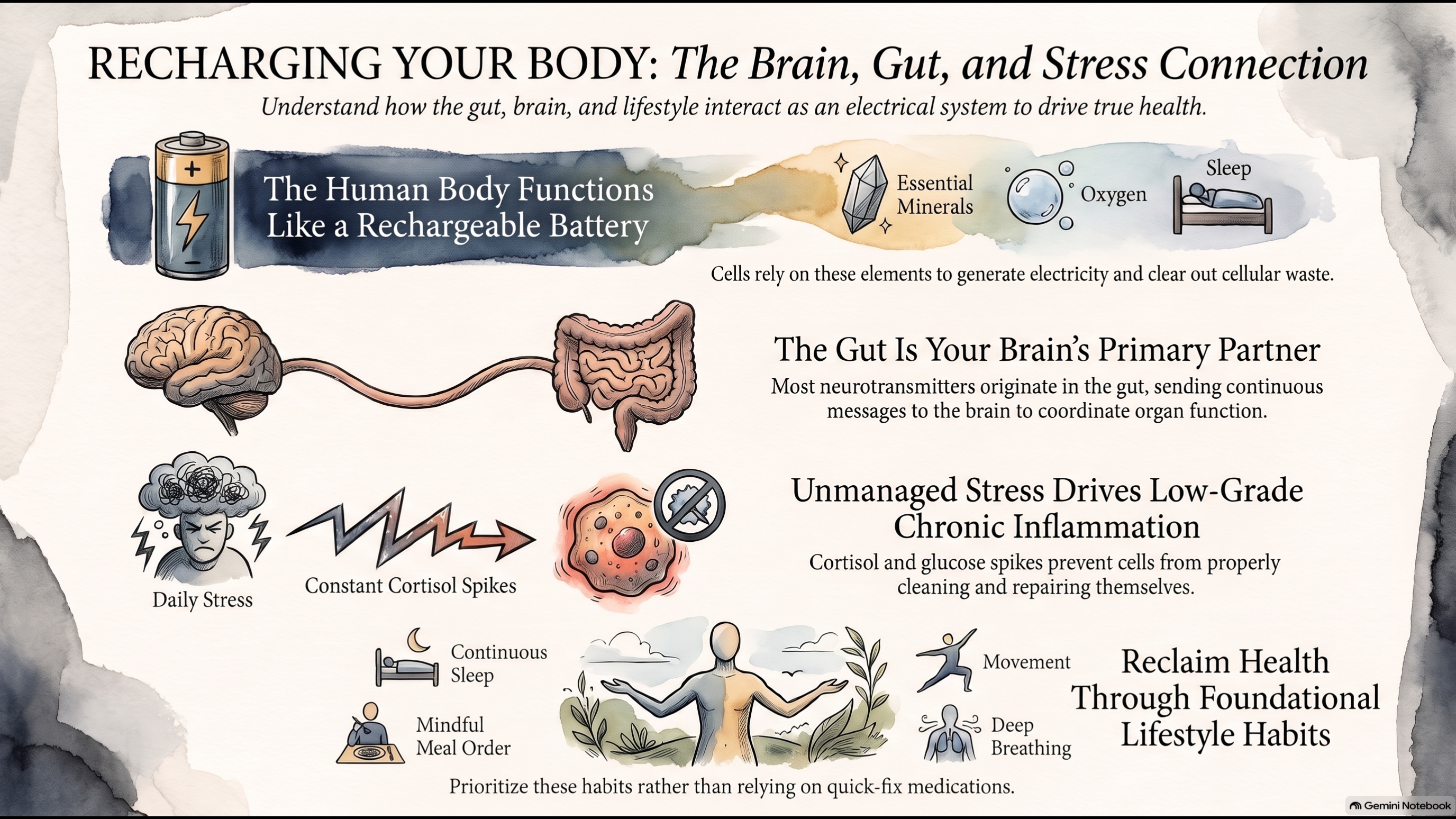
Think of your physical body not as a combustion engine powered strictly by calories, but as a high-voltage electrical grid. Every one of your 37 trillion cells must continually generate an electrical charge to keep you thinking, moving, and breathing. However, while an automobile battery only requires a charge to kickstart the engine, your body operates in a state of perpetual ignition—you are constantly running directly off your biological battery reserve.
To generate that vital electrical charge, your physiology relies on a precise biochemical sequence:
Red Blood Cells: Manufactured inside the marrow of your long bones (the arms and legs). Early-stage osteopenia or osteoporosis can quietly impair healthy red blood cell production long before bone density issues fully manifest.
Oxygen & Iron: Deep pulmonary breathing exchanges vital gases in the lungs. Oxygen then binds to red blood cells using iron as its molecular anchor.
Essential Minerals: The bloodstream must maintain precise concentrations of four critical electrolytes: magnesium, sodium, calcium, and potassium.
The Cholesterol Spark: Inside the cellular chamber, sodium and potassium interact to create an electrical current, utilizing cellular cholesterol as the necessary fuel to ignite energy production.
Micronutrient Cofactors: Essential B vitamins and trace minerals—compounds your body cannot manufacture on its own—act as essential catalysts for the entire system.
As you age or endure chronic stress, this electrical reserve naturally wanes. Simultaneously, basic metabolic firing generates cellular waste—the physiological equivalent of leaving dirty dishes in a sink. If those cellular dishes are not washed away, the cell’s ability to fire degrades.
“Your body is a battery, and the battery works on electricity… The battery can die because we don’t charge it with minerals and B vitamins. Or the alternator goes out. And the alternator… is sleep.” - Dr. Harvey Loomstein
During continuous, high-quality sleep, the brain’s cerebrospinal system activates its glymphatic response. Acting like nighttime street cleaners, this fluid system washes through brain tissue, clearing out metabolic debris and protein buildup.
This mechanism explains a common clinical paradox observed by Dr. Loomstein: patients suffering from chronic fatigue often report lying in bed all day (“sleeping all the time”), yet they remain hopelessly exhausted. Why? Because fragmented or restless sleep fails to achieve the minimum threshold of five continuous hours required to complete the physiological sleep stages. Without that unbroken block, the cerebrospinal street cleaners never turn on. Waking up groggy and irritable isn’t a character flaw—it is the literal physical reality of a brain coated in uncleaned cellular waste due to a broken alternator.
Takeaway 2: The Gut Talks to the Brain Far More Than the Brain Talks to the Gut
We tend to picture the human brain as an arrogant monarch sitting in an isolated control tower, issuing top-down commands to the rest of the body. In reality, the bi-directional highway of the vagus nerve operates heavily in reverse.
The human gut is packed with complex neural networks and a vast microbiome housing trillions of micro-organisms.
This internal ecosystem constantly surveys passing nutrients, digestive speed, and chemical threats.
Counterintuitively, the gut sends significantly more signals upward to the brain than the brain transmits down to the digestive tract. Furthermore, the vast majority of the body’s mood-regulating neurotransmitters are synthesized inside the gut, not between your ears.
Dr. Loomstein describes the gut as the body’s primary “sewer system.” Its job is to process raw materials and eliminate toxic byproducts. If gut motility slows or elimination paths become blocked, metabolic waste cannot exit the body. Instead, toxins recirculate back into the bloodstream, cross the blood-brain barrier, and disrupt delicate electrical signaling.
“There are more messages going up to the brain than the brain down to the gut… Your gut has to work because that’s your sewer.” -Dr Harvey Loomstein
Vagus Nerve Signaling: Operates as a heavy-duty communications cable, constantly carrying status updates from the abdominal organs directly into the brain stem.
Neurotransmitter Manufacturing: Healthy gut flora produce the chemical precursors required for serotonin, dopamine, and GABA production, driving your baseline focus and mood.
Sewer & Drainage Function: Daily gastrointestinal elimination acts as the master valve preventing recirculating waste from triggering neuro-inflammation.
When you experience persistent brain fog, emotional volatility, or memory slips, reaching purely for cognitive exercises or mental strategies will fail if your internal sewer system is backed up and polluting your cellular terrain.
Takeaway 3: Food Order Matters More
Than Restrictive Dieting
Managing metabolic health and systemic inflammation is fundamentally a game of blood sugar control. When a meal causes your blood sugar to spike rapidly above 180 mg/dL, it triggers an immediate, acute inflammatory surge throughout your vascular tree. In response, your pancreas floods your system with insulin to clear the excess glucose. Over time, chronically elevated insulin prevents blood vessels and arteries from expanding naturally, driving up systemic blood pressure alongside blood sugar.
Rather than subjecting yourself to extreme, unsustainable dietary restrictions, Dr. Loomstein points to an empowering bio-mechanical solution: controlling the exact sequence in which food is consumed. Modulating meal order alters gastric emptying rates, stimulates natural gastrointestinal hormone responses (GLP-1), and flattens post-meal glucose spikes.
Consider Dr. Loomstein’s practical real-world strategy: if he chooses to enjoy french fries, he paces their consumption over 45 minutes rather than devouring them immediately. The delayed timing slows down how rapidly carbs enter the small intestine. Similarly, imagine ordering a traditional restaurant meal consisting of a salad, salmon, green beans, a basket of rolls, and a slice of pie:
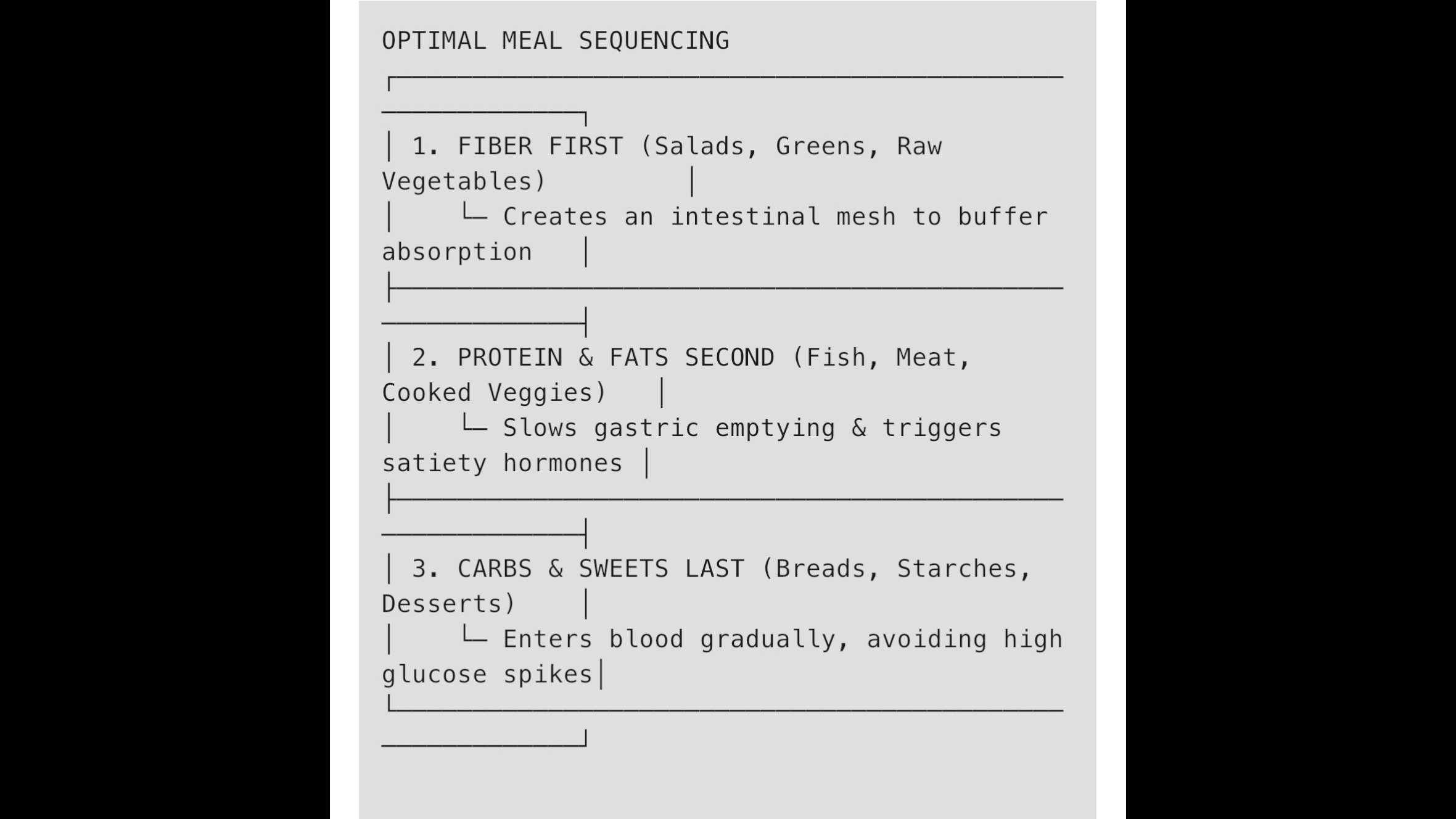
If you start the meal by eating the bread rolls first, the simple starches break down immediately, driving a rapid glucose spike past the 180 mg/dL inflammatory threshold. However, if you restructure the meal order, the metabolic outcome changes entirely:
Fiber First (Salad & Greens): Viscous fiber forms a structural mesh along the intestinal wall, slowing nutrient absorption rates.
Proteins & Fats Second (Salmon & Vegetables): Digested gradually, these macro-nutrients stimulate natural satiety hormones and stabilize gastric motility.
Carbohydrates & Sweets Last (Pie & Bread Rolls): By the time starches hit your system, the physical buffer of fiber, protein, and fat slows their entry into the bloodstream, preventing damaging insulin surges.
Managing your metabolic health does not require living in a state of perpetual food deprivation. By strategically ordering how food enters your digestive tract, you can enjoy a full spectrum of foods while shielding your vascular system from inflammatory damage.
Takeaway 4: Your Brain Can’t Tell Road Rage from a Saber-Toothed Tiger
From an evolutionary standpoint, human survival relies on two distinct physiological operating modes: resting peacefully at a feast, or mobilizing every physical resource to battle a lethal predator. When a threat is detected, the adrenal glands pump cortisol into the bloodstream, elevating heart rate, shunting blood to skeletal muscle, and shutting down non-essential digestion.
Modern life rarely presents physical apex predators, yet human biology has not updated its emergency response system. Your primitive nervous system cannot distinguish between a life-threatening danger and a minor daily annoyance. Getting cut off in gridlock traffic, reading a passive-aggressive email, or stressing over monthly bills triggers the exact same cortisol cascade as an encounter with a wild beast.
“When you get up in the morning and… worry about the bills… all of that goes into creating this thing we call inflammation. Because your brain doesn’t know the difference between that and the saber-toothed tiger. It’s biology.” -Dr Harvey Loomstein
When modern micro-stressors fire continuously without physical movement or conscious downtime, the cortisol response remains locked on high alert. This chronic activation creates low-grade systemic inflammation—a physiological state described in Traditional Chinese Medicine as internal “Fire.”
To extinguish this internal fire, the body requires “Water”—in the form of deep hydration, cellular minerals, and parasympathetic rest. If left unquenched, chronic inflammatory signals (cytokines) flood the system, eventually confusing the immune response and causing it to attack healthy host tissues, laying the foundation for autoimmune conditions.
Common morning habits—such as grabbing a smartphone off the nightstand, scrolling through news feeds, or reviewing stressful schedules before your feet even touch the floor—trap your physical body in an inflammatory state before your day has officially begun.
Takeaway 5: You Have Hidden “Second Organs” Managing Your Health
Conventional medicine frequently treats the human body as a collection of isolated departments, sending patients to distinct specialists for every separate symptom. Integrative functional medicine, by contrast, views physiology as a web of interconnected, dual-organ systems. Dr. Loomstein highlights two paired functional organs that play vital roles in daily health:
The Calf as the Second Heart: The calf muscles act as a crucial mechanical pump returning venous blood from the lower extremities back up to the chest. Furthermore, calf tissue stores specialized muscle insulin. Engaging the calves through simple movements—such as performing seated toe-raises while working at a desk—activates venous blood return and metabolizes stored muscle insulin, driving cellular energy across the body without putting stress on the cardiovascular system.
The Kidney as the Second Skin: The kidneys serve as the internal biological twin to your external skin, filtering fluid balance and extracting toxic metabolic byproducts. When kidney filtration degrades due to chronic dehydration, stress, or mineral imbalances, the body attempts to compensate by pushing waste outward through the dermis. Unresolved skin conditions, rashes, and chronic irritations are frequently external warning signs that internal kidney drainage is falling behind.
Treating skin conditions solely with topical corticosteroid creams without investigating kidney filtration is like wiping smoke off a window while ignoring the fire inside the room. Human physiology operates as an integrated whole, where localized symptoms point to systemic imbalances.
Takeaway 6: Acute Medicine Can’t Cure Chronic Lifestyle Diseases
There is a profound distinction between allopathic emergency medicine and functional lifestyle care. Conventional allopathic care is an absolute triumph for acute trauma; if you sustain a concussion or suffer a compound fracture in an accident, emergency room intervention is essential for saving your life.
However, a breakdown occurs when acute medical models are used to manage chronic, progressive lifestyle conditions like Type 2 diabetes, chronic fatigue, or essential hypertension.
“The problem is when you start treating chronic conditions… with the same drugs you would use in an acute situation. Because that doesn’t control the disease, it just perpetuating it. All you’re doing is treating the symptoms.”-Dr Harvey Loomstein
Pharmaceutical interventions applied to chronic lifestyle conditions suppress outer symptoms, but because conditions like Type 2 diabetes are inherently progressive, suppressing symptoms alone allows the underlying pathology to advance undetected.
Taking a pill to suppress high blood sugar while ignoring basic diet sequencing, sleep debt, and stress cascades is like turning off a fire alarm while the house continues to burn.
Long-term recovery relies on restructuring your fundamental biological environment. Reversing chronic lifestyle degeneration requires returning to non-negotiable physiological basics: deep diaphragmatic breathing, continuous sleep cycles, proper hydration, targeted mineral replenishment, and daily movement.
Conclusion: Reclaiming Control Over Your Invisible Forces
If you are currently struggling with persistent exhaustion, mid-day brain fog, or emotional reactivity, recognize that your body is not broken. Your symptoms are not evidence of laziness or a weak character. They are clear, logical biological signals from an overloaded system whose cellular battery is running low, whose drainage pathways are backed up, and whose internal threat alarm is stuck on high alert.
Restoring your physical system does not require an overwhelming lifestyle overhaul. Instead, focus on three non-negotiable daily habits:
Micro-Adjust Your Food Order: Eliminate acute glucose spikes by consuming fiber and proteins before starches or sweets, and replenish essential electrolyte minerals like magnesium.
Protect Your Sleep and Morning Boundaries: Protect a minimum of five continuous, unbroken hours of sleep each night to enable glymphatic brain cleaning, and spend your first hour awake away from stressful digital screens.
Engage Daily Physical Movement: Support systemic circulation and clear cellular waste through low-impact physical activity, deep diaphragmatic breathing, or simple seated calf pumps throughout your workday.
What is one small biological signal your body has been sending you that you’ve been mistaking for a lack of discipline—and what will you change today to give your body what it actually needs to heal?
~Your Favorite Drill Sergeant, Jay