Stop Drifting: 5 Counter-Intuitive Truths About Avoidance, Discipline, and Taking the Next Honest Action
Related Episode
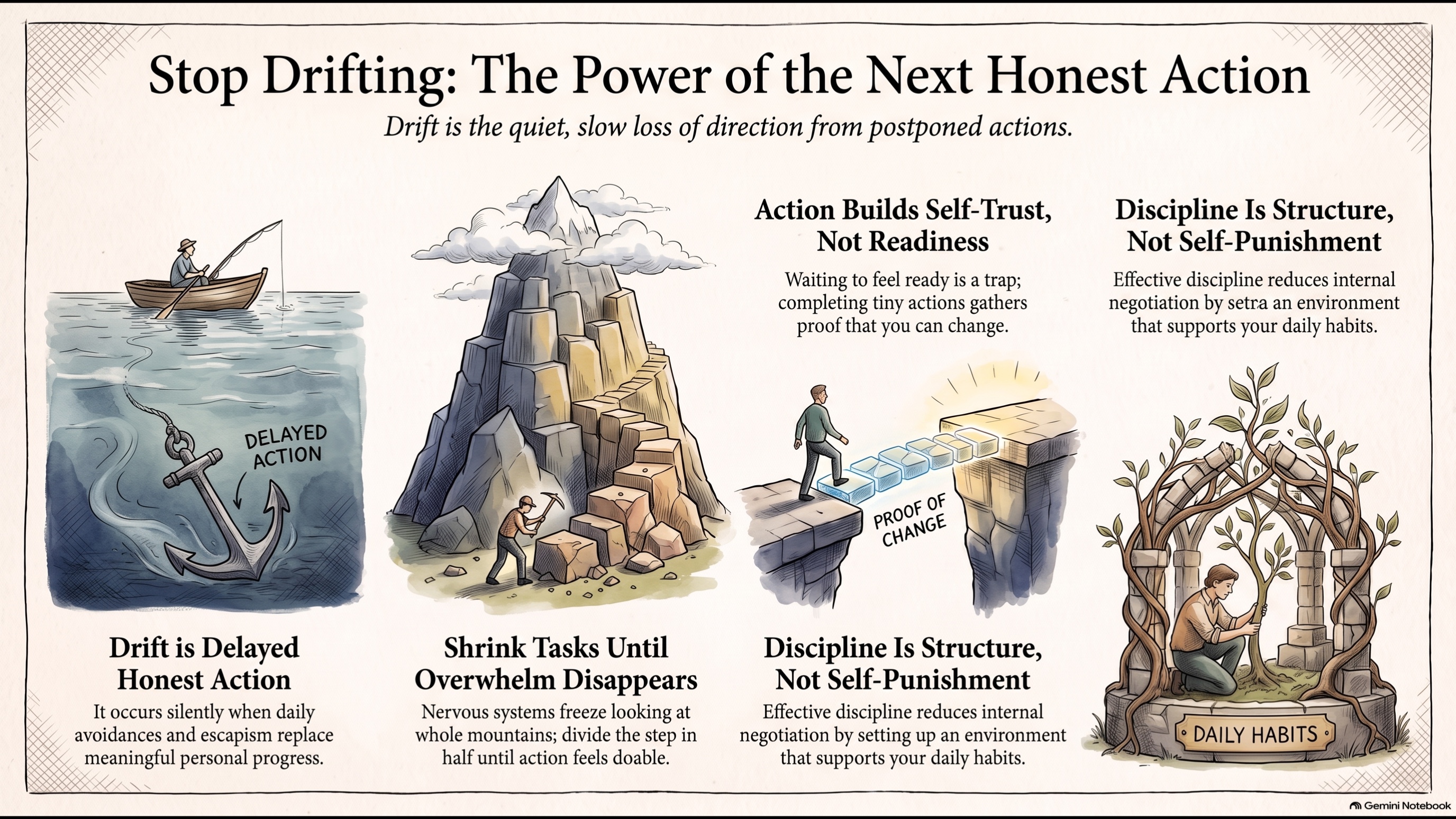
068: Avoidance, Anxiety, and the Structure of DriftOn the surface, your life appears impeccably ordered. You hit your workplace benchmarks, respond to emails, pay your bills on time, and move through social engagements with smooth proficiency. Yet beneath this functional facade lies a quiet, persistent rust: you are moving without momentum. You are not failing dramatically; you are simply drifting.
As psychotherapist Alex Osterman observes, drift is rarely a sudden, catastrophic collapse. Instead, it is the slow, silent loss of direction that occurs when you continuously postpone the next honest action in favor of immediate ease.
Osterman’s clinical framework was forged in the fire of his own personal reckoning. In August 2016, at age 26 while finishing graduate school, he was diagnosed with testicular cancer. While surgery successfully rendered him cancer-free, the psychological aftermath inverted his worldview. Carpe diem transformed from an invitation to take meaningful action into a license for short-term indulgence. Leniencies compounded. Fast food, excessive drinking, and subtle procrastination became his daily baseline. By 2018, a seven-and-a-half-year relationship had dissolved, he was living in his childhood bedroom at his parents’ house, weighing 300 pounds, completely broke, and wondering how his trajectory had degraded so quietly.
His realization was stark: drift does not arrive via a single disastrous decision, but through hundreds of comfortable choices to do what is easy today and defer necessity until tomorrow. To reclaim self-trust and stop numbing our potential, we must examine five radical shifts in how we navigate avoidance, discipline, and personal agency.
- Drift Doesn’t Look Like Chaos—It Looks Like Quiet Escapism
We reflexively imagine that a life off-course looks visibly chaotic: unkept basic obligations, ruined finances, or overt breakdown. In reality, high-functioning drift disguises itself behind routine and met baselines. You perform your required duties, but you systematically postpone the life-expanding initiatives that demand vulnerability, discomfort, or sustained energy.
Everyday avoidance is insidious precisely because it appears socially acceptable:
Morning Hesitation: Hitting snooze three times or spending your first twenty minutes awake passively scrolling through social media feeds instead of initiating your day with intent.
Micro-Delays: Deciding to “send the difficult email tomorrow,” letting administrative tasks pile up, or repeatedly pushing off a necessary medical check-up.
Low-Friction Comforts: Numbing internal friction with short-form videos, streaming binges, alcohol, or fast food to quiet the persistent inner voice telling you that you are off-track.
The Illusion of Preparation: Postponing a crucial conversation, a fitness routine, or a career transition under the endless pretense of waiting to “feel ready.”
These subtle evasions provide immediate short-term relief, but that relief functions like an artificial sweetener. Your brain detects the initial gratification signal, but because the underlying psychological need or task remains unaddressed, the psyche remains hollow and craves further consumption. Every time you choose short-term relief over necessary confrontation, you condition your nervous system to flee.
“A lot of the times we end up in spots where we are training ourselves to, when something feels difficult, escape, find relief—versus what happens when I confront that, and the short-term relief costs people their long-term goals.” — Alex Osterman
- Intellectual Insight Is Worthless Without “Lived Evidence”
Modern self-improvement culture has cultivated a silent epidemic: the hyper-knowledgeable procrastinator. Armed with podcasts, behavioral psychology books, clinical terminology, and self-analysis, high-functioning individuals can articulate their trauma, explain their nervous system responses, and diagnose their behavioral patterns with clinical precision. Yet they wake up every morning and repeat the exact routines that keep them paralyzed.
This reveals a critical therapeutic boundary: there is a profound difference between logically comprehending a concept in your intellect and feeling and experiencing change within your physical body and daily reality.
Intellectualizing a behavioral pattern is often just a sophisticated form of avoidance. Analyzing your fear creates the soothing illusion of progress without requiring you to assume the physical risk of action. Consuming information feels like work, but until your physical body steps into the arena, your baseline remains entirely untouched.
Real psychological transformation requires “boots-on-the-ground” execution that directly contradicts your brain’s historical assumptions about what you can endure. Information is simply potential energy; only physical action creates the “lived evidence” required to convince the psyche that a new reality is possible.
- Overcoming Avoidance Requires the “Next Honest Action” (Make It Uncomfortably Small)
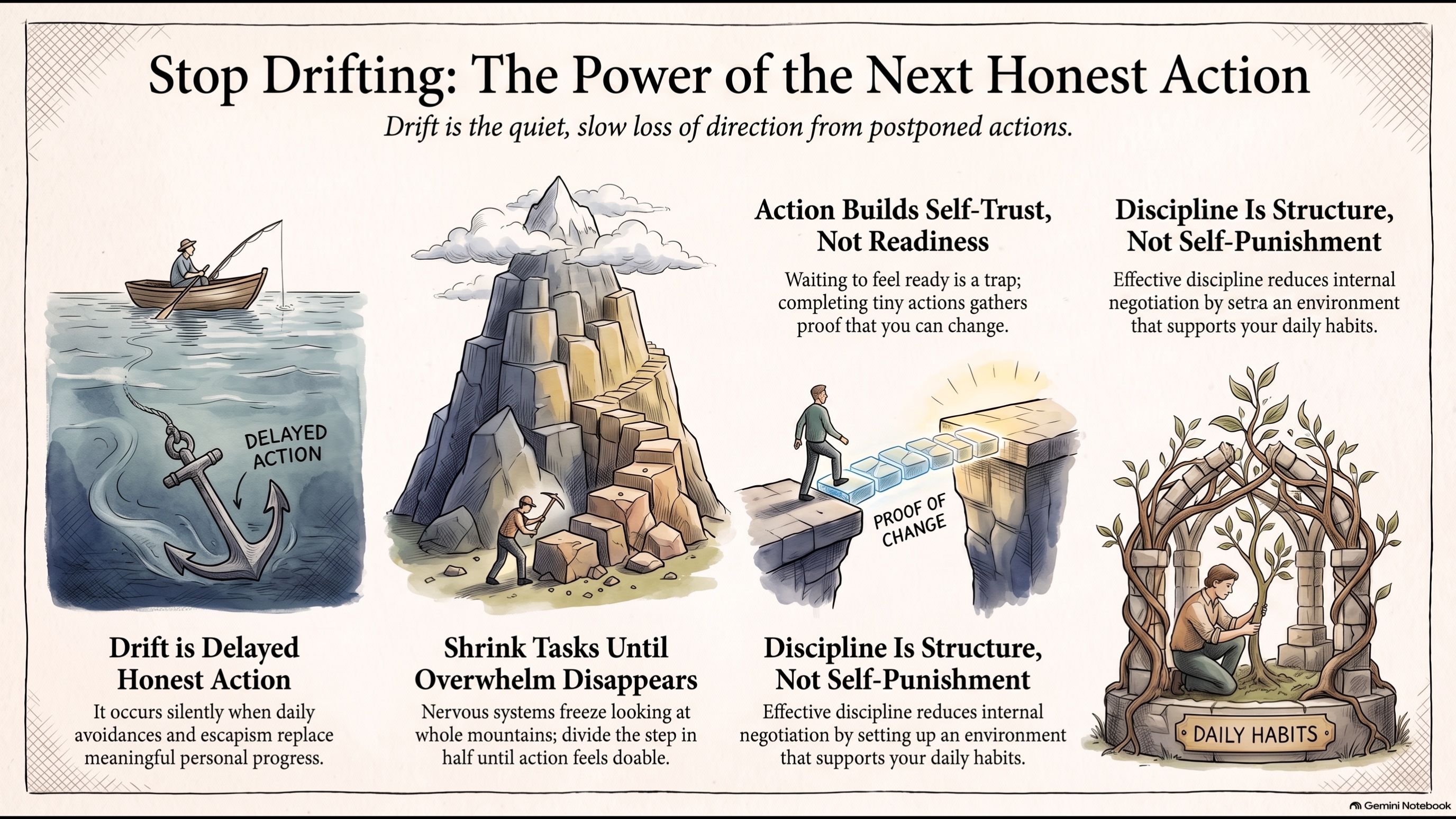
When simple tasks induce overwhelming anxiety, it is usually because you are trying to consume the entire mountain in a single glance. By projecting your mind toward the summit—worrying about every future hurdle, potential failure, or how you might appear to others—you overload your nervous system and trigger freeze responses.
To break this paralysis, you must shrink your focus down to the Next Honest Action. An action is “honest” when it directly addresses the avoided core issue rather than substituting secondary busywork to manufacture a false feeling of productivity.
When resistance is high, execute the Rule of Division: take the required action and halve it. If it still triggers hesitation or anxiety, halve it again. Continue dividing the task until it becomes so uncomfortably small that your nervous system can no longer justify paralysis.
Consider Osterman’s clinical work with a client suffering from severe anxiety surrounding his workday. The client was fully capable once at his job, but the morning routine generated paralyzing dread. Rather than trying to fix the client’s entire relationship with work, Osterman stripped the morning down to radical micro-steps: Get up from the bed. Put your left foot on the floor. Put your right foot on the floor. Take one step. By focusing solely on executing individual physical movements, the client put on his uniform, arrived at work, and discovered his anxiety vanished the moment action replaced anticipation.
This philosophy extends to basic environmental anchors, a lesson Osterman absorbed during his own rock-bottom moment in 2018. Returning to his childhood home broke and severely overweight, he asked his father for direction: “I screwed up. What do I do?” His father’s response was blunt: “I’ve already told you what to do. It’s up to you whether you’re going to follow it or not.”
What surfaced in Osterman’s mind was his father’s relentless past advice: Make your bed.
“It was the first piece of evidence of, ‘Hey, this small piece of your world is in order.’ … Bit by bit, it just became bringing order to an expanding capacity of the self.” — Alex Osterman
Making the bed was not a magical fix, but it was tangible proof that a small quadrant of his chaotic world was under control. By logging these micro-actions daily in a dated notebook, you compile an undeniable paper trail of gathered evidence. Over time, that log proves to your mind that you are accountable to your word, systematically restoring broken self-trust.
- Real Discipline Reduces Negotiation—It Is Not Self-Punishment
Most people misinterpret discipline as a punitive weapon—beating themselves up with harsh internal criticism, forcing extreme routines out of shame, or using exercise as punishment for eating choices. But using self-flagellation as motivation is psychologically unsustainable.
Beating yourself up works like hitting a horse with a stick: you may achieve a short burst of speed, but eventually, the horse throws you off and kicks you into the dirt. Real, enduring discipline relies on supportive structures rather than internal violence.
Punitive Discipline (“The Stick”) VS Supportive Discipline (“The Carrot”)
Driven by shame, guilt, and self-criticism. (Punitive)
Driven by self-trust, clarity, and respect for agency.(Supportive)
Uses self-punishment (e.g., forced exercise to pay for bad diet).(Punitive)
Uses environment design to make desired actions seamless.(Supportive)
Yields temporary motion followed by exhaustion and collapse.(Punitive)
Yields sustainable consistency through reduced mental load.(Supportive)
Fuels relentless internal courtroom debates.(Punitive)
Eliminates negotiation through pre-decided boundaries.(Supportive)
True discipline is the art of environmental and temporal design built to eliminate internal negotiation. It transforms the internal command structure. When the underlying impulse whispers, “I don’t want to,” supportive discipline automatically reframes the thought into: “Oh, that means I have to.”
This reframe relies entirely on pre-setting your physical boundaries:
Remove Morning Decision-Making: If you plan to attend an early 5:15 AM group workout, set your alarm for 5:00 AM, and lay out your workout clothes, shoes, and filled water bottle the night before. At 5:00 AM, you do not debate whether you feel like training; you simply put on the clothes waiting in front of you.
Establish Temporal Hard-Stops: If late-night snacking is eroding your health, set an absolute boundary that dinner ends at 7:00 PM. The kitchen is closed. This removes the ongoing mental bargaining at 9:00 PM because the boundary has already made the choice for you.
When you design an environment that supports your intentions, doing the right thing becomes the baseline path of least resistance.
- A “Slip” Is Narrative Feedback, Not Final Failure
Setbacks are an inevitable reality of behavioral change. However, how you frame a stumble determines whether you make a course correction or descend into total abandonment.
A slip is a temporary deviation—a piece of objective narrative feedback designed to help you analyze environmental friction or unrealistic pacing. Failure only occurs when you decide to stop trying entirely and abandon the endeavor.
When a slip happens, the most urgent priority is rapid re-exposure. In exposure therapy, if an individual experiences a frightening encounter with a dog, one of the most effective psychological interventions is to safely interact with another dog immediately. Delaying re-exposure allows the brain to stigmatize both the event and the individual’s perceived capability. If you slip on your diet, miss a workout, or yield to procrastination, you must return to the behavior immediately before your brain stigmatizes the setback into a permanent identity.
Reframing setbacks requires a clear distinction between blame and responsibility:
Blame looks backward, fixating on who caused past dysfunction, external hardship, or emotional wounds.
Responsibility looks forward, recognizing that regardless of who caused your initial circumstances, you remain the sole author (“protagonist”) responsible for writing your current and future chapters.
Osterman recalls a pivotal moment during his early recovery, struggling through agonizing gym lunges alongside his brother at 300 pounds. Exhausted and embarrassed, Osterman wanted to surrender and walk out. His brother, a quiet introvert who rarely offered unsolicited commentary, looked at him and said simply: “It is good that you stayed, even though you wanted to leave.” Later, his brother shared Theodore Roosevelt’s famous text, The Man in the Arena.
The lesson was profound: progress is not about flawless performance or external approval. It is about staying in the discomfort of the arena, enduring the attempt, and taking ownership of the next rep despite every impulse to flee.
- Conclusion: The One-Question Self-Audit
You do not need to overhaul your entire life overnight, nor do you need to wait for a surge of motivation, perfect clarity, or absolute confidence to begin. Real transformation is built by systematically refusing to evade the immediate, uncomfortable step sitting directly in front of you.
To identify where your real work lies, engage in Jungian shadow work: inspect your emotional friction. Notice where a specific thought, conversation, or task makes you “sink in your chair,” feel an uncomfortable emotional charge, or feel as though an unwelcome spotlight has suddenly turned on you. That exact point of discomfort is the thread you must pull.
Ask yourself this single auditing question today:
Where am I evading right now, and what is the smallest honest action I can take today to give myself evidence that I can still move?
Locate the friction. Apply the Rule of Division until the step is uncomfortably small. Execute it immediately, record the finished step in your dated log as gathered evidence, and allow yourself to acknowledge that victory. Tomorrow, wake up and repeat the process.
Transformational change is never instant; it is the compound interest of taking one honest action today, and having the discipline to do it again tomorrow.