The Messy Middle of Transformation: 6 Uncomfortable Truths About Self-Trust, Burnout, and Starting Over
Introduction: The Quiet Panic of Looking “Perfect”
What happens when your life looks completely successful on the outside, but feels entirely hollow on the inside? It is quiet work, pretending you’re fine. You can draw a commanding salary, hold an impressive title, and fly off on spontaneous weekend getaways, all while waking up every morning with a cold, heavy sense of dread. External success is the ultimate camouflage for deep psychological exhaustion. It allows you to check every box of societal achievement while quietly dissolving on the inside, going through the motions of a life you no longer actually inhabit.
This was the hidden reality for Jennifer, a licensed mental health therapist based in Myrtle Beach, South Carolina. To any outside observer, she had arrived: she was serving as the director of a mental health clinic inside a county jail for a corporate healthcare provider while simultaneously building a private practice on the side. On paper, she was unstoppable; in reality, she was running on fumes inside an environment that drained her soul. Her ultimate leap—from corporate jail director to full-time solo practice owner and international traveler—reveals a fundamental truth about human growth. Real transformation is never clean, linear, or comfortable. It happens in the “messy middle”; that uncertain, terrifying space where you must learn to trust yourself long before you have a single piece of evidence that everything will work out.
Takeaway 1: Your “Successful” Life Might Be Hiding Severe Disconnection
High achievement is often a trauma response dressed up as a work ethic.
While running a high-stress clinic inside a corporate-run county jail, Jennifer faced severe systemic staffing shortages, bureaucratic red tape, and deep clinical misalignment. Her default coping mechanism, rooted in past survival wounds, was classic high-performer behavior: hustle harder, power through, and ignore her body’s distress signals. Burnout didn’t make her work drop; it made her double down, using extreme productivity to avoid asking why she felt so profoundly disconnected from her life.
Her moment of truth didn’t come from a dramatic public breakdown, but from a quiet, devastating realization. While flipping through a prayer journal she used exclusively during church services, Jennifer stumbled upon an entry written exactly 365 days earlier. Reading her own handwriting from a year prior, she froze: she had written down the exact same words, the exact same sadness, and the exact same core values disconnect. A full year had evaporated while she powered through, changing nothing. Realizing that high productivity was merely masking internal decay made it impossible to keep pretending.
“The version of me before I took these brave steps was like a shell of myself because of burnout.” -Jennifer Cangeme
Takeaway 2: Entrepreneurship Reactivates Old Trauma Wounds
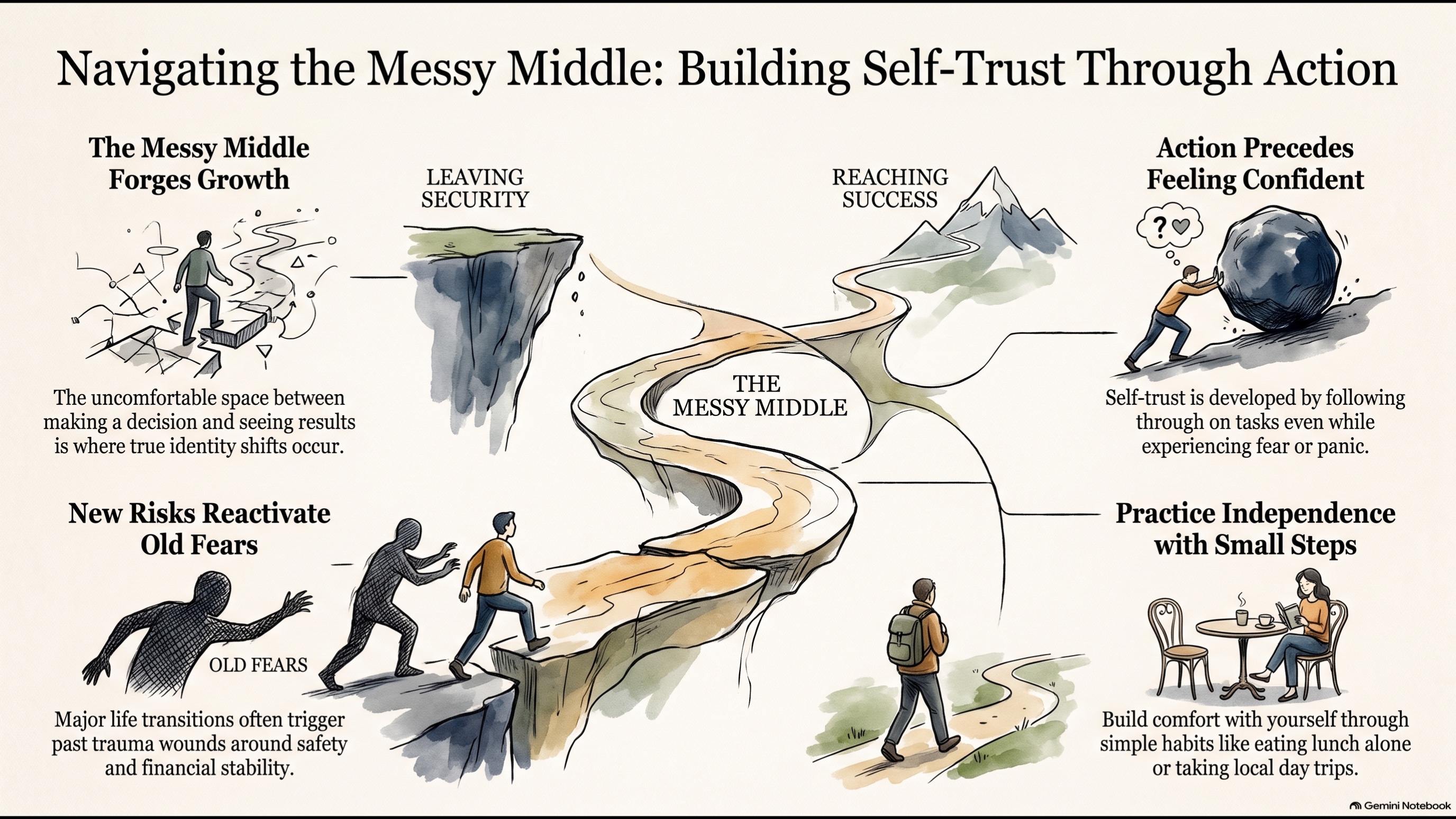
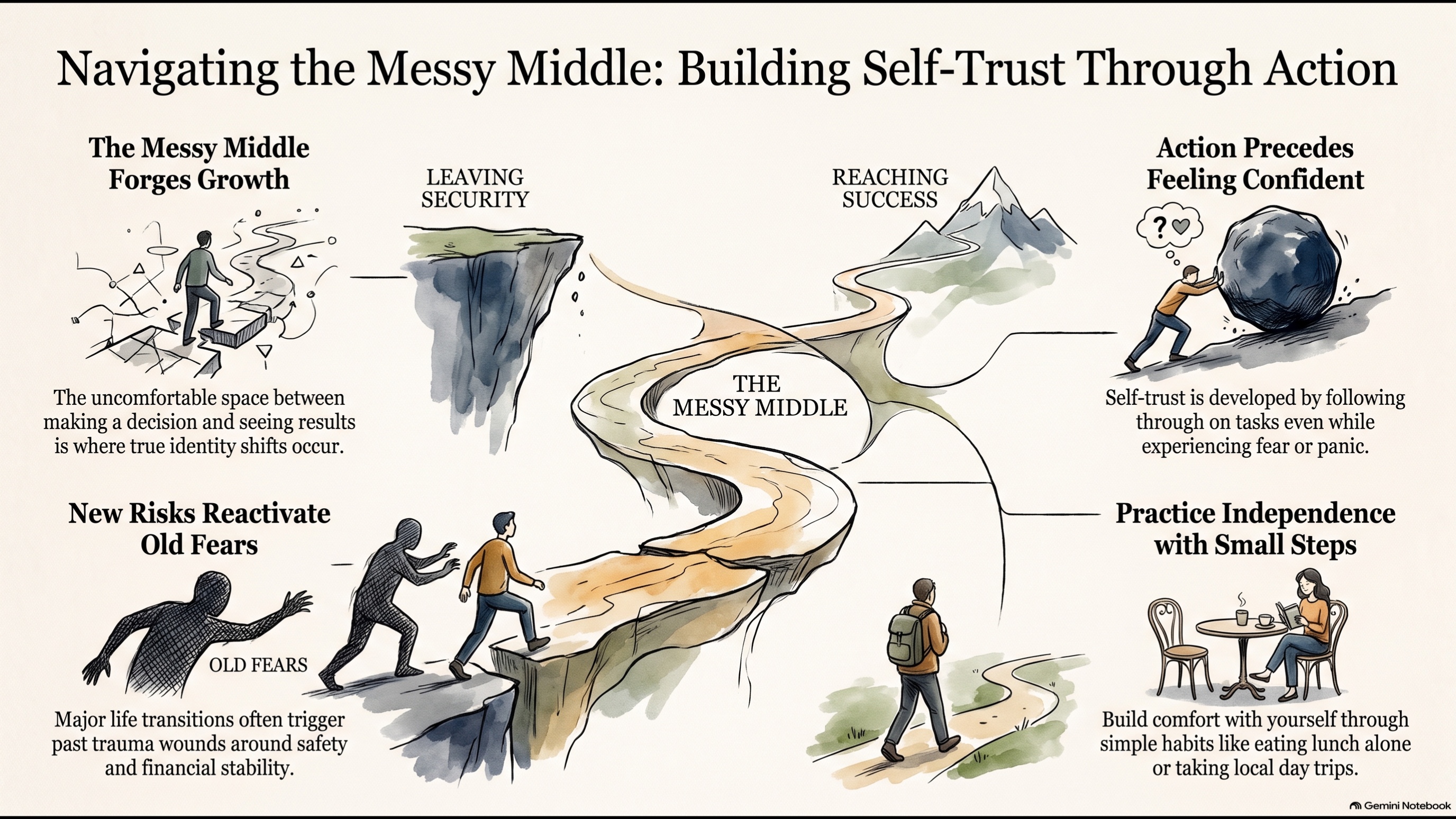
Leaving the golden handcuffs of a corporate job to build something of your own isn’t just a career move; it’s an emotional earthquake. Stepping into the unknown reactivates primitive survival mechanisms, particularly around money, safety, and stability. If you built a secure life from scratch, taking professional risks directly threatens the safety structures you worked so hard to erect.
You can do years of therapy and feel completely healed in your personal relationships, only to find those exact same terror responses screaming back to life the moment you step out on your own.
This psychological friction often traps people in planning paralysis. Jennifer spent an entire year stuck in the mental loop of thinking, worrying, and delaying before she finally translated her decision into a structured, six-month action plan. Yet even after executing that plan, the fear didn’t magically vanish.
Entrepreneurship teaches you that panic and progress frequently share the same room. You can wake up having a panic attack about visibility at 8:00 AM and still execute your daily strategic tasks by noon; moving forward isn’t about feeling calm, but about taking the step while your hands are shaking.
“We don’t talk enough at how [trauma wounds] are activated in entrepreneurship.” - Jennifer Cangeme
Takeaway 3: Without Boundaries, You Will Recreate Corporate Chaos in Your Own Business
The most ironic trap for new entrepreneurs fleeing corporate burnout is that they walk away for freedom, only to immediately rebuild the exact same prison under their own name. Frightened by financial uncertainty, new business owners operate from survival panic: they say “yes” to every client, overpack their schedules, and panic-buy endless courses and coaching programs out of a desperate attempt to feel safe. Without explicit boundaries, you simply replace a corporate boss with a hyper-vigilant internal tyrant.
Your nervous system defaults to familiar patterns of overwork unless you consciously disrupt the cycle.
Transitioning into authentic self-employment requires ruthless awareness of how easily corporate chaos masquerades as “hustle.”
Achieving real freedom isn’t about working harder for yourself; it requires learning to pause, setting unshakeable boundaries around your time, and overriding the urge to hoard commitments as an emotional shield against anxiety.
Takeaway 4: Solo Travel Is a Masterclass in Self-Trust (Not Just a Vacation)
While business risks tend to trigger financial terror, solo travel serves as a powerful proving ground for self-reliance. Jennifer highlighted a fascinating personal paradox: as an 18-year-old, she fearlessly rented rooms in strangers’ houses through early Airbnb and navigated foreign train stations in France without hesitation. Decades later, as a 41-year-old clinical professional, taking risks in business triggered intense anxiety. Confronting the unknown in travel bypasses business defenses, directly healing inner child wounds and proving that you are fully capable of navigating unexpected chaos.
Traveling independently forces a clear boundary between being physically alone and feeling lonely. Far from being a luxury escape, solo travel converts solitude into a grounding, restorative practice. It creates the quiet space necessary for deep self-reflection, proving that learning to love your own company is the bedrock of trusting your own judgment in everyday life.
“I love the quiet, I love being alone… It’s like calming for me, it’s peaceful for me. I can be intentional, I can self-reflect.” -Jennifer Cangeme
Takeaway 5: Building Courage Starts with a “Reservation for One”
You don’t need to purchase an international flight to build self-trust.
The primary barrier keeping people from doing things alone is rarely physical safety or logistics; it is the agonizing fear of judgment and concern over how they are perceived by strangers. We avoid solitude because we dread looking awkward, unloved, or out of place in public spaces.
Courage is a muscle built through micro-steps. Start small: take yourself out to lunch alone, sitting with your meal and existing in the space without reaching for your phone as an emotional shield. Once you normalize local solitude, expand your perimeter by taking a single-day solo trip—such as driving two hours to explore a historic nearby town like Charleston. Designing and executing an entire afternoon strictly on your own terms provides the exact emotional evidence your brain needs to handle larger life transitions.
Takeaway 6: The “Messy Middle” Is Proof of Growth, Not Proof of Failure
Walking away from predictable security triggers a volatile cocktail of panic, excitement, and terror. Sweating through self-doubt or wondering if you made a catastrophic mistake after walking away from comfort is entirely normal. These feelings don’t mean you chose the wrong path or that you are failing; they simply signify that you have entered the transitional space between who you were and who you are becoming.
Uncertainty is not proof of a mistake; it is the signature of growth. Feeling terrified merely confirms that you are operating outside your past survival patterns. The messy middle is the active, non-negotiable workspace where you forge the internal resilience and self-trust required to sustain the freedom you fought for.
Conclusion: What Would Happen If You Trusted Yourself a Little Bit More?
True transformation never offers a guaranteed roadmap before you step off the cliff. Whether you are dismantling corporate burnout, launching a business, navigating a major identity shift, or learning to explore foreign cities alone, self-trust is forged through movement, not standing still. You don’t need to eliminate fear to rewrite your life; you only need to stop letting old survival responses drive your decisions.
You don’t have to be fearless to take the next step; you just have to be willing to act. What boundary have you been avoiding setting out of fear? What decision have you put off because you’re worried about how it might look?
Consider what your life could become if you decided to trust yourself just a little bit more today; whether that means launching the business, ending the burnout cycle, booking the solo trip, or simply taking yourself out for a reservation for one.